- €23.50 Adult ticket 2026
- €43.50 King's Ticket (both castles)
- ~45 min Guided tour duration
- 15–20 min Uphill walk from village
- No state pass Privately owned — not covered by Bavarian pass
Why Hohenschwangau is the key to understanding Neuschwanstein
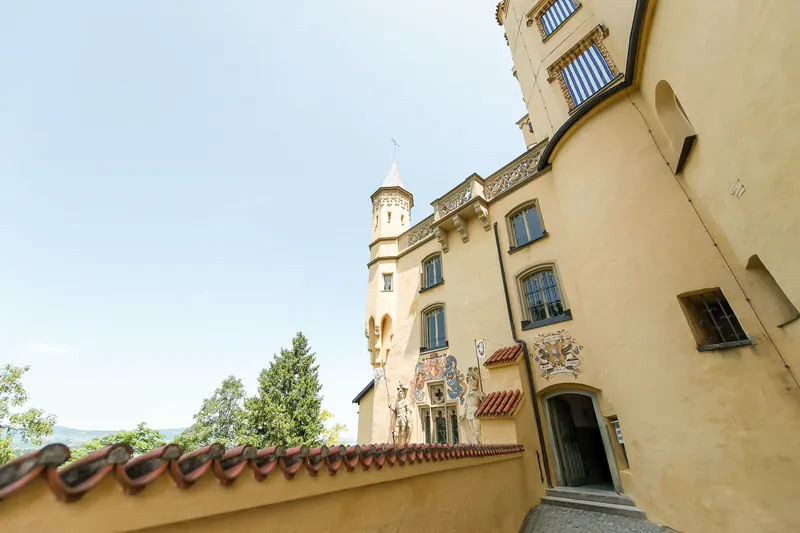
Hohenschwangau is not a warm-up act for Neuschwanstein — it's the origin story. Built between 1833 and 1837 by Ludwig's father Maximilian II on the ruins of a medieval fortress, this yellow neo-Gothic palace became the summer home where the future king spent his childhood surrounded by murals of medieval German legends, swan imagery, and the Lohengrin tale that would later saturate every room of Neuschwanstein. Ludwig's telescope for watching the construction of Neuschwanstein still sits in his room. Seeing Hohenschwangau first makes Neuschwanstein legible as the final chapter of a story that began here.
Unlike Neuschwanstein — which was largely unfinished at Ludwig's death — Hohenschwangau is fully furnished with its original 1830s Biedermeier interiors and more than 90 wall paintings. It draws roughly 300,000 visitors a year against Neuschwanstein's 1.4 million, which means calmer tours and less queuing pressure. It shares the same village and the same Ticket Center, so logistics are straightforward. The King's Ticket combining both castles (€43.50 regular, €48.50 online) is the natural choice for most visitors. For the bigger picture on who King Ludwig II was — the Fairy-Tale King who built these palaces from his private fortune — we have a full biography guide.
For the rest of your planning: Neuschwanstein tickets and prices · getting there from Munich · inside Neuschwanstein — the rooms and viewpoints · Linderhof Palace guide.
Other experiences you might enjoy
Hohenschwangau Castle sits in the same compact valley as Neuschwanstein Castle, Ludwig's grander creation up the hill, and the two share one Ticket Center and one village — most visitors combine them on a single day. The village also includes the Museum of the Bavarian Kings on the shores of the Alpsee lake, with the 700-year Wittelsbach dynasty story and a panoramic window framing both castles. From Munich, the full-day guided coach covers Neuschwanstein and Linderhof Palace together, with a lunch stop in Hohenschwangau village — giving you time to see the yellow castle from the outside and walk the lakeside path. Independent travellers arrive via Füssen and bus 73 or 78, the same route for both castles.
From medieval ruin to royal summer home
What is now Hohenschwangau Castle began as a medieval fortress called Schwanstein, first documented in the 12th century and held by the knights of Schwangau who served as ministeriales of the Welf dukes. (Confusingly, the two castles later swapped names: the older twin fortress on the ridge where Neuschwanstein now stands was originally called "Hohenschwangau.") Over the centuries the site changed hands and was repeatedly damaged in regional conflicts, eventually falling into ruin.
In 1832 Crown Prince Maximilian of Bavaria — later King Maximilian II, and Ludwig's father — purchased the ruin. Between 1833 and 1837 he had it rebuilt as a romantic neo-Gothic summer and hunting residence under the theatre painter and architect Domenico Quaglio the Younger, with work continued after Quaglio's 1837 death by Joseph Daniel Ohlmüller and Georg Friedrich Ziebland; state-funded additions continued to around 1855. The swan motif — the castle's name means roughly "High Swan District" — runs throughout.
Hohenschwangau became the summer residence of the royal family, and Ludwig II spent much of his childhood here surrounded by the painted legends that shaped his imagination. When Maximilian died in 1864 and the 18-year-old Ludwig became king, he moved into his father's rooms. From 1869 Ludwig used Hohenschwangau as his base while overseeing the construction of Neuschwanstein across the valley. After Ludwig's death in 1886 and his mother Marie's in 1889, the palace eventually passed to the Wittelsbacher Ausgleichsfonds (Wittelsbach Compensation Fund) in 1923 — which still owns it today. It opened to the public as a museum in 1913 and suffered no damage in either World War.
Inside Hohenschwangau: the rooms on the tour

Visits are by guided tour only, roughly 30–45 minutes, in groups with limited capacity. Tours run with a German- or English-speaking guide, and portable audio guides cover about a dozen further languages including French, Spanish, Italian, Japanese, and Mandarin. The route involves about 180 steps (90 up, 90 down) with no visitor elevator. Photography inside is banned — no photos or video of any kind, including out of the windows. Rucksacks, large bags, strollers, and prams are not allowed inside; there are limited lockers.
The interior preserves its original Biedermeier furnishings and more than 90 wall paintings depicting the history of Schwangau and medieval German legends. Highlight rooms:
- Hall of Heroes (Heldenhalle): the large banquet hall, its murals illustrating the Wilkina Saga and the hero Dietrich von Bern.
- Hall of the Swan Knight (Schwanrittersaal): a dining room decorated with scenes of the Lohengrin legend — the story that fused with Wagner's opera in Ludwig's imagination.
- Music Room (King's quarters): contains the maple square piano associated with Richard Wagner, Ludwig's reading chair, and the telescope through which he watched Neuschwanstein being built across the valley.
- Tasso Room (King's bedroom): murals of Rinaldo and Armida from Tasso's Jerusalem Delivered; Ludwig later had crystals set into the ceiling and back-lit to create a starry-sky effect.
- Orient Room: Queen Marie's Moorish-style bedchamber, reflecting Maximilian's 1833 travels to Greece and Turkey.
- Berchta Room: Queen Marie's writing room, with murals on Charlemagne.
Hohenschwangau ticket prices for 2026
| Ticket type | Adult | Reduced | Child 7–17 |
|---|---|---|---|
| Hohenschwangau Castle only | €23.50 | €19.50 | €12.00 |
| Neuschwanstein Castle only | €21.00 | €20.00 | Free |
| Museum of the Bavarian Kings | €14.50 | €13.50 | Free |
Reduced price applies to seniors 65+, students with ID, disabled visitors, and holders of a hotel guest card or Königscard. Under-7s are free for Hohenschwangau; under-18s are free for Neuschwanstein. Neuschwanstein is state-owned; Hohenschwangau is privately owned — Bavarian state palace annual or 14-day passes do not admit you to Hohenschwangau.
Combination tickets 2026
| Combo | Includes | Regular | Reduced | Child 7–17 |
|---|---|---|---|---|
| King's Ticket | Neuschwanstein + Hohenschwangau | €43.50 | €38.50 | €12.00 |
| Prince Ticket | Neuschwanstein + Museum | €33.50 | €31.50 | Free |
| Wittelsbach Ticket | Hohenschwangau + Museum | €36.00 | €31.00 | €12.00 |
| Swan Ticket | All three (Neuschwanstein + Hohenschwangau + Museum) | €56.00 | €50.00 | €12.00 |
Best value pick: For most first-time visitors, the King's Ticket (€43.50, or €48.50 online) is the right choice — it covers both castles, is logistically simple since both share one Ticket Center, and makes adding Hohenschwangau to a Neuschwanstein day straightforward. Book online at least 1–2 weeks before any summer weekend to avoid sell-outs.
Opening hours and crowds in 2026
Hohenschwangau Castle is open daily except 24, 25 and 31 December and 1 January. Guided tours run:
- Summer (28 March–15 October 2026): 9:00 a.m.–4:30 p.m. last tour
- Winter (from 16 October 2026): 10:00 a.m.–4:00 p.m. last tour
The Ticket Center opens at 8:00 a.m. (closes 4:00 p.m. summer / 3:30 p.m. winter). Hohenschwangau draws roughly 300,000 visitors a year — well under a quarter of Neuschwanstein's 1.4 million — which makes tours feel noticeably calmer. But it is not a guaranteed walk-up in peak season: same-day tickets at the Ticket Center sell out by late morning on busy summer days. For summer, weekends, and public holidays, book online at least 1–2 weeks in advance. In November–March, same-day availability is much more feasible; arriving by 8:30 a.m. is usually sufficient.
Combining Hohenschwangau with Neuschwanstein from Munich
$88 · ★ 4.6 (15,000+ reviews) · ~10.5 hours · Free 24-hour cancellation
Most visitors combine Hohenschwangau and Neuschwanstein on the same day — the two castles are 300 m apart in the same valley, share one Ticket Center, and complement each other perfectly: Hohenschwangau is the intimate, fully-furnished childhood home; Neuschwanstein is the grand theatrical creation it inspired. The full-day coach from Munich includes a lunch and photo stop in Hohenschwangau village — time to see the yellow castle exterior, walk the Alpsee lakeside path, and eat at one of the village restaurants before heading up to Neuschwanstein.
- Round-trip coach from Karlsplatz 21, Munich
- Neuschwanstein + Linderhof in one day
- Lunch stop at Hohenschwangau village
- Free cancellation up to 24 hours before
Planning on your own? See our full guide to getting to Neuschwanstein from Munich — the train, bus, and car options are the same for Hohenschwangau since both castles share the same village.
From $88. Availability and final price on GetYourGuide.
What to do in Hohenschwangau village
The compact village at the foot of the two castles contains everything you need for a full castle day:
- Ticket Center Hohenschwangau — the single point of sale for tickets to both castles and the Museum of the Bavarian Kings. Note the strict no-stopping zone on the street out front; use parking lots P1–P4.
- Museum of the Bavarian Kings — opened 2011, at Alpseestraße 27 directly on the Alpsee lakeshore (~3 minutes from P4). Tells the 700-year Wittelsbach dynasty story across 16 rooms including original exhibits (an original coat of Ludwig II), interactive media, and a 21-metre panorama window framing Hohenschwangau, the Alpsee, and the mountains. Adult €14.50; runs daily 9:00 a.m.–5:00 p.m. year-round.
- The Alpsee — a clear alpine lake with a lakeside walking path, boat rental, and the Alpseebad bathing area. A peaceful contrast to castle queues.
- Restaurants and hotels — Hotel Müller, Hotel Alpenstuben, Café/Restaurant Kainz ("Dorfwirt"), and several others including Hotel Schlossblick and the AMERON Neuschwanstein Alpsee Resort.
- Parking (P1–P4): cars €12.00 for up to 6 hours (then €1/hour to a €16 daily max); buses (P1 + P4) €35/day; motorbikes (P2 + P3) €5/day. P4 (by the Alpsee) is closest to the museum and the lake walk.
2026 traffic note: Renovation of the König-Ludwig Bridge (B16) in Füssen is restricting traffic to one-way from about 4 May 2026 until approximately early August 2026. Allow extra travel time from Füssen during this window if arriving by car.
Hohenschwangau vs. Neuschwanstein — what each gives you
The two castles complement rather than duplicate each other:
- Hohenschwangau is fully furnished and authentically lived-in, with complete original 1830s Biedermeier interiors — the actual childhood rooms, the telescope, the Wagner piano. Tours run ~30–45 minutes and feel calmer. It is privately owned (not a state museum) and is not covered by Bavarian state passes.
- Neuschwanstein is grander and more theatrical but only ~14 rooms were ever finished; it draws 5× more visitors per year and requires much more advance booking. Its UNESCO inscription, Marienbrücke viewpoint, and Singers' Hall are the headline draws.
Seeing Hohenschwangau first makes Neuschwanstein legible as the "last chapter" of a story that began in its painted halls. Many independent reviewers call Hohenschwangau underrated and even prefer it. If you can only tour one interior, most first-timers still choose Neuschwanstein for its fame and views — but the King's Ticket (€43.50) makes adding Hohenschwangau inexpensive and logistically easy. Allow at least 2.5 hours between your two castle tour slot times, and plan Hohenschwangau first.
How to reach Hohenschwangau from Munich
Hohenschwangau and Neuschwanstein share the same village, so transport is identical. From Munich:
- By train + bus: regional trains run Munich Hauptbahnhof → Füssen roughly hourly, ~2 hours; then bus 73 (toward Steingaden/Garmisch) or bus 78 (toward Schwangau) to the "Hohenschwangau/Alpseestraße" stop, ~10 minutes. Total ~2.5–3 hours door to village. The Bayern-Ticket (around €29–34 for one person, valid from 9:00 a.m. weekdays / all day weekends) covers train and bus for up to five people.
- By car: ~1.5–2 hours via the A7 (exit Füssen) then B17/B16 toward Schwangau/Königsschlösser; park in P1–P4 (€12 for up to 6 hours).
- By guided coach from Munich: full-day tours from Karlsplatz 21 include a Hohenschwangau village stop plus Neuschwanstein and Linderhof — the most convenient option if you want to see all three in one day.
From the village, Hohenschwangau Castle is a 15–20 minute uphill walk on a gentle, stair-free path, or a ~10-minute horse-drawn carriage ride (€5.50 up / €3.00 down, paid to the driver; suspended in winter). There is no shuttle bus to Hohenschwangau — the shuttle serves only the Neuschwanstein/Marienbrücke side. See our guide to getting to Neuschwanstein from Munich for full transport comparisons and realistic timings.
Hohenschwangau Castle FAQ
Is Hohenschwangau Castle worth visiting alongside Neuschwanstein?
Yes — and most visitors who do both say Hohenschwangau is underrated. It is fully furnished with original 1830s Biedermeier interiors (Neuschwanstein is largely unfinished), far less crowded (about 300,000 visitors per year vs. 1.4 million at Neuschwanstein), and shares the same village and Ticket Center, making logistics simple. The King's Ticket combining both castles costs €43.50 regular (€48.50 with online booking fee), which makes adding it inexpensive. Allow at least 2.5 hours between your two tour slot times, and see Hohenschwangau first.
How much does Hohenschwangau Castle cost in 2026?
An adult ticket is €23.50 in 2026 (reduced €19.50 for seniors 65+, students, disabled visitors, and hotel guest card holders; children 7–17 €12; under 7 free). Online reservations add a €2.50 per-person service fee. Hohenschwangau is privately owned and is NOT covered by any Bavarian state palace pass — those cover only Neuschwanstein and other state properties.
Do I need to book Hohenschwangau Castle in advance?
Hohenschwangau is less pressured than Neuschwanstein, but it is not a guaranteed walk-up in summer. Same-day tickets sell out by late morning on busy days in peak season. Booking online at least one to two weeks ahead for summer and weekend visits is strongly advised. Note that tickets cannot be exchanged or cancelled once booked.
Is there a shuttle bus to Hohenschwangau Castle?
No. From the village it is a 15–20 minute uphill walk on a gentle, stair-free path, or a horse-drawn carriage ride (€5.50 uphill / €3.00 downhill; suspended in winter). The shuttle bus in the area serves only the Neuschwanstein/Marienbrücke side. Neuschwanstein itself requires a steeper 30–40 minute walk or the shuttle.
Was Hohenschwangau Castle included in the July 2025 UNESCO listing?
No. The July 2025 UNESCO inscription covers "The Palaces of King Ludwig II of Bavaria: Neuschwanstein, Linderhof, Schachen and Herrenchiemsee" — all castles Ludwig II built himself. Hohenschwangau was built by his father Maximilian II and is owned by the Wittelsbach family, not the Bavarian state, so it was not included in the designation. That said, the overall increase in visitors following the UNESCO inscription will affect Hohenschwangau too, since it sits in the same village.