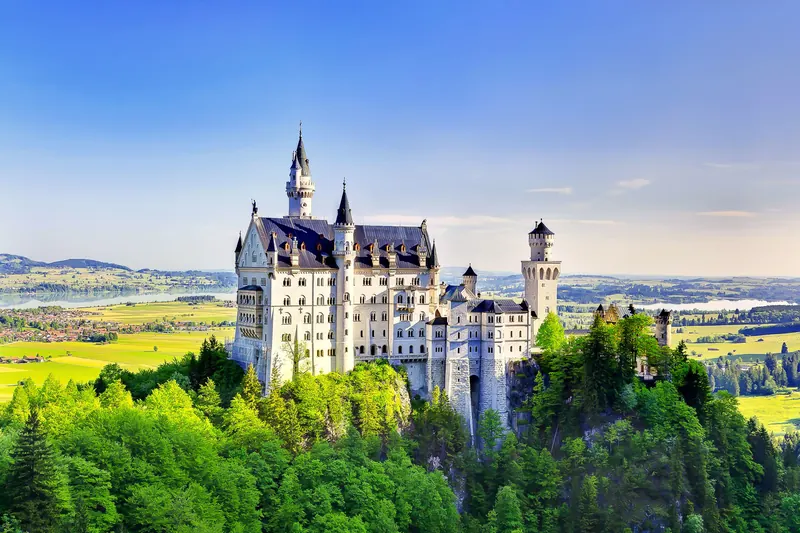
- 1845–1886 Ludwig II's lifespan
- Age 18 When he became king
- 3 palaces Neuschwanstein, Linderhof, Herrenchiemsee
- 172 days Total time spent in Neuschwanstein
- UNESCO 2025 His palaces inscribed 12 July 2025
The king who built the world's most famous castle to escape the world
Ludwig II of Bavaria spent 22 years on the throne of a kingdom he found largely irrelevant, in a constitutional monarchy he experienced as a cage. His response was to build: three enormous castle-dreamworlds funded from his personal fortune, each a different fantasy of royal absolutism, medieval legend, and Wagnerian theatre. The supreme irony is that Neuschwanstein — conceived as a private refuge from modernity — became the world's archetype of the fairy-tale castle, directly inspiring Disney's Sleeping Beauty Castle, and now draws well over a million visitors a year to a building Ludwig never intended for public eyes. On 12 July 2025 it was inscribed as a UNESCO World Heritage Site alongside Linderhof and Herrenchiemsee, becoming Germany's 55th.
Understanding Ludwig makes the castles legible. Neuschwanstein is not a medieval fortress — it's an inhabitable opera set, designed by a theatrical scenographer and saturated with Wagnerian murals. Linderhof is a jewel-box homage to Louis XIV, the French Sun King, and the only palace Ludwig lived to see finished. Herrenchiemsee, on a lake island, was a literal Versailles copy, its Hall of Mirrors longer than the original. All three reveal themselves as the psychological inverse of Ludwig's political life: unable to be an absolute monarch in fact, he built stage sets in which he could feel like one.
Planning a visit to Ludwig's castles? Our guides cover Neuschwanstein tickets and prices, getting there from Munich, inside the castle — rooms and viewpoints, and Linderhof Palace. For the childhood home that shaped Ludwig's imagination, see our Hohenschwangau Castle guide.
Other experiences you might enjoy
Ludwig II's Bavaria is richer than any single castle. Most visitors combine Neuschwanstein Castle — his most theatrical creation — with Linderhof Palace, his intimate Versailles-inspired retreat and the only palace he completed. His childhood home, Hohenschwangau Castle, sits directly across the valley and is where the swan legends and Wagnerian imagery that saturate Neuschwanstein first took root in the young king's imagination. From Munich, full-day guided trips reach both Neuschwanstein and Linderhof in a single day, with a stop at the Marienbrücke viewpoint for the iconic photo above the Pöllat Gorge. The woodcarving village of Oberammergau and nearby Füssen make natural add-ons for travellers staying overnight.
Early life: a childhood in Hohenschwangau's painted halls
Ludwig Otto Friedrich Wilhelm was born on 25 August 1845 at Nymphenburg Palace in Munich, the elder son of Crown Prince Maximilian and Marie of Prussia. The family belonged to the House of Wittelsbach, one of Europe's oldest ruling dynasties — governors of Bavaria since 1180, as dukes, electors, and finally kings from 1806. Ludwig spent much of his childhood at Hohenschwangau Castle, the neo-Gothic summer residence his father had rebuilt from ruins near Füssen, its walls painted with murals of medieval German legends and swan motifs. This storybook setting, combined with a strict and emotionally distant upbringing, nurtured the boy's vivid imagination and a pronounced sense of his own sovereignty.
When Maximilian II died suddenly, Ludwig became king on 10 March 1864 at just 18 — "much too early," as he later admitted. His youth and striking looks (he stood roughly 6 feet 4 inches, about 193 cm) made him instantly popular. He retained his father's ministers and policies, but his true interests lay in art, music, and architecture, not governance.
Wagner: patron and obsession
Ludwig's fascination with Richard Wagner began when he saw Lohengrin at age 15. One of his first acts as king in 1864 was to summon the 51-year-old composer — then a political exile hounded by creditors — to Munich, rescuing him financially. Wagner later wrote after their first meeting that the young king was "so beautiful and wise, soulful and lordly, that I fear his life must fade away like a divine dream in this base world."
The patronage transformed music history. Munich saw the premieres of Tristan und Isolde (1865), Die Meistersinger (1868), Das Rheingold (1869), and Die Walküre (1870). Ludwig's financial support made possible the Bayreuth Festspielhaus (inaugurated 1876) and the premiere of Parsifal (1882). Without Ludwig, Wagner almost certainly could not have completed the Ring cycle or Parsifal. Wagnerian themes saturate his castles: Neuschwanstein's murals depict Tannhäuser, Tristan, Lohengrin, and Parsifal; the Singers' Hall evokes the Wartburg song contests; the Throne Hall was conceived as a Hall of the Holy Grail.
The castles: stage sets for a private kingdom
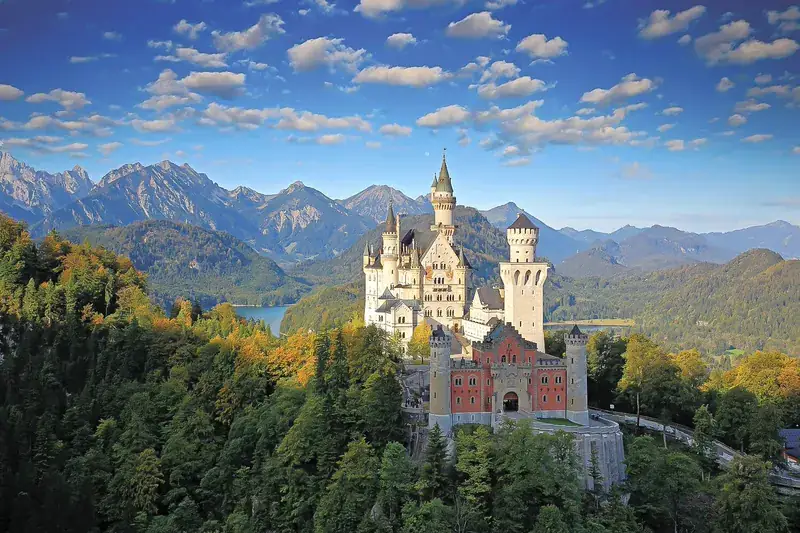
Neuschwanstein (foundation stone September 1869) was conceived as a Romanesque-revival fantasy of medieval knighthood and Wagnerian legend, perched on a crag above his childhood home. Tellingly, Ludwig hired the theatrical scenographer Christian Jank — not a trained architect — to design it; parts of the castle were based directly on opera stage sets. It was, in effect, an inhabitable theatre. The Wartburg in Thuringia served as a direct architectural model.
Linderhof (1869–78, the only palace completed in his lifetime) was an intimate neo-French Rococo "royal villa" inspired by the Petit Trianon at Versailles, complete with a Venus Grotto — an artificial cave with electric lighting and a shell-shaped boat, evoking Wagner's Tannhäuser. Herrenchiemsee (begun 1878, never finished), built on an island in Lake Chiemsee, was an explicit homage to Versailles and to Louis XIV. Its Hall of Mirrors is longer than the one at Versailles itself.
The castles were the psychological inverse of his political reality: unable to be a true sovereign in a constitutional monarchy, Ludwig built stage sets in which he could feel like a medieval king or a Bourbon absolutist. From 1875 he increasingly lived by night and slept by day. The total cost exceeded 14 million marks — his personal debt, not a draw on the Bavarian treasury — and it was this insolvency that ultimately brought him down.
2026 visitor note: Since the July 2025 UNESCO inscription, Neuschwanstein interior tickets sell out weeks in advance in summer. Book early or join a guided coach from Munich that reserves your slot. See our Linderhof guide for the reopened Venus Grotto (from April 2025) and 2026 prices.
A king with little power — and the conspiracy that removed him
Ludwig's reign coincided with the violent birth of the German Empire. Bavaria sided with Austria in the 1866 Austro-Prussian War and lost; afterward it was forced into a mutual-defence pact with Prussia. When the Franco-Prussian War came in 1870–71, Bavaria fought alongside Prussia. Ludwig's signing of the Kaiserbrief in November 1870 — formally inviting Prussia's King Wilhelm I to become German Emperor — gave the new empire a veneer of voluntary federation rather than Prussian conquest. Historians believe this cooperation was secured in part by a secret payment from Bismarck, drawn from confiscated Hanoverian funds, that helped Ludwig finance his building projects.
Ludwig exercised little political power and showed little appetite for it. He delegated steadily to ministers and retreated into his private world after 1871. By 1885–86 his personal debts exceeded 14 million marks, foreign banks threatened to seize his assets, and he demanded a 6-million-mark credit from his cabinet. They refused — and instead turned to a legal mechanism: a king could be removed if declared insane.
On 8 June 1886, a commission of four psychiatrists led by Dr. Bernhard von Gudden signed a report diagnosing Ludwig with incurable "paranoia," declaring him permanently unfit to rule. None had personally examined him; Gudden had seen him once, twelve years earlier. Bismarck himself was sceptical, dismissing the dossier as "rakings from the King's wastepaper-basket." The procedure was not provided for in the Bavarian constitution. Ludwig was deposed, his uncle Prince Luitpold installed as regent, and after briefly arresting the first commission at Neuschwanstein — local loyalists rallied to his defence — the king was seized on 12 June and taken to Berg Palace on Lake Starnberg.
Death at Lake Starnberg — a question that has never been settled
On the evening of Whit Sunday, 13 June 1886, Ludwig and Gudden went for a walk along the lake, with Gudden dismissing the attendants. Neither returned. Around 11 p.m. both were found dead in shallow water near the shore. The official verdict was suicide by drowning, with Gudden dying trying to restrain him. But the account has been questioned for over a century:
- Ludwig was a strong swimmer, and the water was only waist-deep where the bodies were found.
- The autopsy reportedly found no water in his lungs — usually a hallmark of drowning (though laryngospasm can explain this).
- Gudden's body showed facial injuries and possible strangulation marks.
- The cause-of-death line on the king's autopsy report was reportedly left blank.
Three competing theories persist. Murder: Ludwig's fisherman Jakob Lidl later left notes claiming the king was shot from the shore during an escape attempt, and a Countess displayed a coat with bullet holes said to be Ludwig's (lost in a fire). Escape gone wrong: that Ludwig meant to flee to loyalists and died of a heart attack or stroke in the cold (12°C) water, possibly after overpowering Gudden. Suicide: supported by servant accounts of Ludwig requesting poison and tower keys in his final days, and his own earlier threats to kill himself if his castles were taken. The House of Wittelsbach has consistently refused to allow the body to be exhumed — so the mystery is likely permanent.
See Neuschwanstein and Linderhof in one day from Munich
$88 · ★ 4.6 (15,000+ reviews) · ~10.5 hours · Free 24-hour cancellation
The full-day coach from Munich visits both Neuschwanstein and Linderhof — Ludwig's two UNESCO-listed palaces — in a single day. Audio commentary covers his biography, his relationship with Wagner, and the story behind each castle. Interior tickets for both can be purchased on the bus before arrival. A stop at Hohenschwangau village gives you time for lunch and photos of Ludwig's yellow childhood home across the valley.
- Round-trip coach from Karlsplatz 21, Munich
- Neuschwanstein + Linderhof in one 10.5-hour day
- Audio commentary on Ludwig II in 9 languages
- Interior tickets optional (€42 adult, paid on bus)
- Free cancellation up to 24 hours before
Prefer a smaller group with skip-the-line entry? The premium small-group tour ($226, ★ 4.8) includes castle entry, snacks, and a live English-speaking guide throughout.
Legacy: how a private refuge became a global symbol
Ludwig died deeply unpopular with his government but beloved by ordinary Bavarians, and the mystery only deepened his legend. Neuschwanstein — which he ordered destroyed after his death and never intended for public eyes — opened to paying visitors just six weeks after he died. The construction debts were cleared by 1899, and the palaces became a major income source for the Wittelsbachs before passing to the Bavarian state in 1923.
Walt Disney, who toured Bavaria in 1935, drew on Neuschwanstein's silhouette for Sleeping Beauty Castle at Disneyland, which opened in 1955. Ludwig, who spent only about 172 days in Neuschwanstein and slept just 11 nights there, had unwittingly created a global emblem of romance. When Minister-President Markus Söder welcomed the July 2025 UNESCO inscription, he declared: "when seeing the castle, some people worldwide may think of Disney — but no: Neuschwanstein is and remains the original from Bavaria."
2025–2026: centenary, UNESCO, and a TV series
On 12 July 2025 "The Palaces of King Ludwig II of Bavaria: Neuschwanstein, Linderhof, Schachen and Herrenchiemsee" were inscribed as UNESCO World Heritage Site no. 1726. Neuschwanstein had also just completed its largest restoration since the 19th century — over €22 million on the state rooms — with a permanent cap of 45 visitors per tour group now in place.
2026 marks 140 years since Ludwig's death. The Museum Starnberger See is opening a long-term exhibition, "Ludwig II — The Final Days of the Fairy Tale King," staged as "a drama in four acts," from 17 June 2026 at Berg. A memorial service continues annually at the Votive Chapel. An eight-part historical crime drama series, "Ludwig," entered production in late 2025 with a planned 2027 premiere — reframing his death as a cold case.
King Ludwig II FAQ
Was King Ludwig II of Bavaria really mad?
The question is genuinely unresolved. The 1886 psychiatric commission that declared him insane never personally examined him, and modern historians and psychiatrists remain sharply divided. A 2020 peer-reviewed study (Steinberg and Falkai, European Archives of Psychiatry) concluded Gudden's team did not misdiagnose Ludwig by the standards of their own era, while other experts — including the eminent psychiatrist Heinz Häfner — argued he showed no signs of psychosis at all. Various later diagnoses have been proposed (schizotypal personality, Pick's disease, narcissistic personality) without consensus. What is clear is that the insanity label was politically convenient, and the deposition procedure was not provided for in the Bavarian constitution.
Did King Ludwig II pay for Neuschwanstein with his own money?
Yes — a crucial point often misunderstood. Ludwig funded his castles from his personal fortune, civil-list income, and loans, not directly from the Bavarian treasury. Neuschwanstein cost roughly 6.2 million marks in his lifetime; Linderhof about 8.5 million; Herrenchiemsee some 16.6 million. By 1885–86 his total personal debt exceeded 14 million marks, which triggered the political crisis that ended in his deposition. The Bavarian state itself was not bankrupted.
How many days did Ludwig II actually spend in Neuschwanstein?
Only about 172 days in total — and just 11 nights — according to the Bavarian Palace Administration. He moved into the unfinished castle in 1884 but only around 14 of the planned 200 rooms were ever finished before his death. He ordered it destroyed when he was arrested; the order was not carried out, and Neuschwanstein opened to the public just six weeks after he died.
How did Neuschwanstein inspire Disney?
Walt Disney toured Bavaria in 1935 and drew on Neuschwanstein's silhouette — particularly its towers and cliff-top setting — for Sleeping Beauty Castle at Disneyland, which opened in 1955. The connection is well-documented for Sleeping Beauty Castle specifically. Ludwig, who built Neuschwanstein as a private retreat and ordered it destroyed after his death, had unwittingly created the world's archetype of the fairy-tale castle.