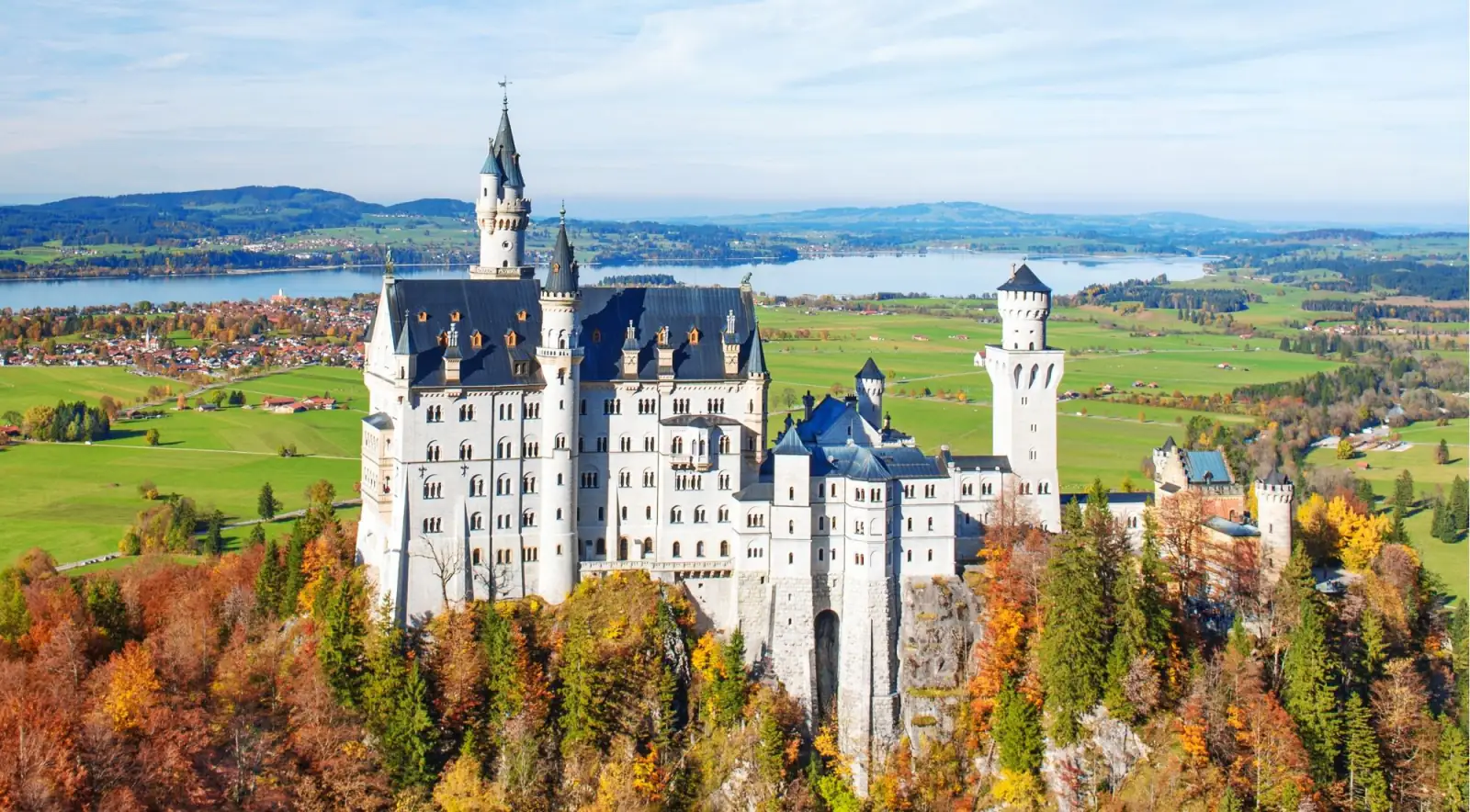


Marienbrücke
The classic castle-and-forest view. Morning sun hits the castle's front façade; the bridge itself photographs best in soft morning or late light. Expect congestion from mid-morning.
Come in October and you get four things in one visit that no other month combines: golden larch, beech and maple foliage framing the castle's white limestone, first snow dustings on the Tegelberg and Säuling peaks behind it, crisp low light that flatters the façade, and materially thinner crowds than the July–August peak. The trade-offs are just as concrete — shorter daylight, wetter and foggier weather, and a genuine risk that a late-October storm strips the leaves or ices Marienbrücke shut. Timing matters more here than in almost any other month: foliage in the Hohenschwangau and Füssen valley typically peaks around 10–20 October, and the castle switches to shorter winter opening hours on 16 October. Book a timed-entry interior ticket in advance and go early.
Two more things make 2026 an unusually good October. Neuschwanstein and Ludwig II's other palaces were inscribed as a UNESCO World Heritage Site on 12 July 2025, and the multi-year interior restoration was declared complete on 7 July 2025 — so this is the first year in a long time with no scaffolding anywhere inside. If you are still choosing a month, our month-by-month best-time guide compares all twelve; for the logistics this page assumes, see tickets, prices & booking and getting there from Munich.
The appeal is specific and visual, not vague. The castle sits on a rocky spur at roughly 965 m above the village of Hohenschwangau, over the Pöllat gorge and between the Alpsee and Schwansee lakes. In autumn the surrounding mixed forest — dominated by beech, with larch and maple — turns a kaleidoscope of oranges, yellows and browns, and the white limestone façade stands out against it in a way flat summer green never allows. A landscape photographer writing for On Landscape notes that the best shots are often away from the castle, along the roughly 5 km Alpsee shore path, where the beech forest is "spectacular."
The details that recur in trip reports and photo guides are worth planning around:
One traveller writing for Travels with Tricia summarised the draw plainly: "Rich yellow, copper and crimson leaves framed the world-famous castle." A visiting photographer described "its white sandstone walls a contrast above a palette of red hues that would have done any master painter proud." The façade is in fact limestone, not sandstone — a common error worth getting right — but the impression is exact.
If you want the room-by-room detail behind that façade, our guide to what's inside Neuschwanstein covers the 14 rooms on the tour route and the best viewpoints for the shot everyone comes for.
October rewards travellers who build a day around the castle rather than sprinting to it. Linderhof Palace — Ludwig's only completed palace and part of the same 2025 UNESCO listing — is the strongest wet-weather pairing and is included on the full-day coach from Munich. Hohenschwangau Castle, Ludwig's boyhood home directly across the valley, and the Museum of the Bavarian Kings on the Alpsee shore are both good bad-weather fallbacks. The Tegelberg cable car gives the aerial view over both castles and the Forggensee while it is still running, and Füssen's old town, the Lechfall and the Kalvarienberg hill fill a rained-off afternoon. Further out, the rococo Wieskirche is about 40 minutes away, painted Oberammergau makes a scenic autumn drive, and the Zugspitze — Germany's highest peak, roughly 1.5 hours away — is usually snowy by October.
There is no fixed date. Colour depends on how dry the summer was and how early the first cold snap arrives.
The first two weeks of October give the best chance of beautiful autumn colours in Bavaria generally, but early October still has a bit of green mixed in with the reds and oranges in the valley. What you gain is reliability: summer opening hours still run to 15 October, the weather is milder, and the Forggensee is still a full lake. If you are travelling with fixed dates and cannot gamble, early October is the safer half of the month.
A Bavaria photography guide puts it precisely: higher altitudes change in late September, while "the valleys and lakes experience their peak around October 10–15." Hohenschwangau and Füssen sit at roughly 800–900 m, squarely in that valley band. Allowing for year-to-year drift, 10–20 October is the window to target. Higher slopes and the Tegelberg — especially the golden larch — turn earlier, from late September, so a well-timed mid-October visit can catch turned larch on the slopes above and peak beech in the valley below.
Locals on Tripadvisor repeatedly warn that "a couple of days of rain and wind and all leaves are off the trees by mid-October," and that by mid-to-late October brown dominates. Against that, one much-cited traveller photographed peak colour on 20 October in one particular year — evidence that the window moves by a week or more between years. Late October is either glorious late colour or bare branches with a first dusting of snow as compensation. By November the valley is generally past peak and bare branches are likely, with a higher chance of snow instead.
Check before you commit: foliage timing moves by roughly ±1 week year to year, so check the live webcams and conditions on hohenschwangau.de and tegelbergbahn.de three to five days before you travel, rather than trusting any published date — this page included.
Füssen sits at the wet, cold edge of the Alps — a Köppen Dfb climate with around 1,700 mm (67 in) of annual precipitation, making it one of the wettest parts of Germany. These are the autumn normals for the Schwangau, Füssen and Hohenschwangau area:
| Metric | September | October | November |
|---|---|---|---|
| Average high | ~16 °C / 61 °F | ~11.5 °C / 53 °F | ~6.3 °C / 43 °F |
| Average low | ~8–9 °C / 46–48 °F | ~2.4 °C / 36 °F | ~1 °C / 34 °F |
| Rainfall days | ~12 | ~12–12.5 | ~9 |
| Precipitation | ~150 mm / 5.9 in | ~105 mm / 4.1 in | ~63 mm / 2.5 in |
| Snow days | Occasional | ~3.9 | Several |
| Daylight | ~12.5 h | ~10.9 h falling to ~9.5 h | ~9 h |
On 1 October, sunrise is around 07:16 and sunset around 18:56 (CEST) — about 10 h 51 m of daylight, and shortening fast. The clocks change on the last Sunday of October (CEST to CET), pulling sunset back to roughly 17:00. For anyone day-tripping from Munich, that single hour is a real planning constraint, not a detail.
Füssen is overcast or mostly cloudy about 58% of the time in October (Weather Spark). Snow is possible: the town averages about 3.9 snow days in October and more falls on the peaks, though valley accumulation early in the month is unusual rather than unheard of. From autumn through spring, Föhn conditions can persist for three or four days at a stretch — against one or two in summer — bringing warmth, strong wind and exceptional visibility, often followed by rain when the Föhn breaks.
October is materially colder — highs drop roughly 4–5 °C from September — with fewer but still frequent rain days and much shorter days. What it offers in exchange is clearer, crisper high-pressure spells than a humid Bavarian summer typically delivers.
These are normals, not a forecast. Check a seven-day forecast and the DWD (Germany's national weather service) before you travel. An October week can swing from unseasonable sunshine to sleet.
Neuschwanstein drew about 1.1 million visitors in 2025, remaining Bavaria's most-visited palace — the Spitzenreiter — according to the official Schlösserbilanz 2025 presented by the Bavarian Palace Administration on 11 February 2026. The granular figure reported via dpa was 1,086,432. Across all its sites the administration recorded 5.11 million visitors, around 2% up on 2024, and its president is Hermann Auer. For context: 2024 saw 1,082,816; 2023 about 850,000 (depressed by post-Covid recovery and active restoration reducing group sizes); pre-pandemic 2019 about 1.48 million; and the all-time record was roughly 1.57 million in 2014. More than 70% of visitors come from abroad, per the Bavarian Finance Ministry in 2026.
A correction worth knowing: many English-language articles still cite "1.4–1.5 million," and some cite "1.7 million." The accurate current figure is about 1.08 million (2024/2025). Palace Administration president Hermann Auer has said pre-pandemic levels will likely not be reached again, because tour-group sizes were permanently reduced after the restoration.
The official summer picture is stark. Per neuschwanstein.de, "in the summer around 6,000 visitors a day stream through rooms that were intended for a single inhabitant," peaking at up to about 10,000 on the busiest days; the Covid low point was around 1,080 a day. July, August and September are the busiest months. No official month-by-month breakdown exists, but October is structurally quieter for three concrete reasons: the northern-European season ends, the summer timetable ends on 15 October (which means fewer daily tour slots afterwards), and daylight shortens. Trip reports consistently describe October as significantly less crowded.
The quietest times within the month are the same as any month, only more effective: early morning (the first tours) or after about 15:00, and weekdays over weekends.
Put plainly: a visit on 20 October has a two-hour-shorter operating window than one on 10 October. That is the difference between a comfortable day trip from Munich and a tight one.
Full 2026 prices, refund rules and sell-out timing are in our tickets, prices and booking guide; the Hohenschwangau Castle guide covers the King's Ticket side of the combination.
Verify before you book. Exact season dates shift by a day or two year to year (the 2026 summer season is quoted as 28 March – 15 October), prices and booking fees change, and the group-size cap should be re-confirmed for your travel date on neuschwanstein.de or hohenschwangau.de.
Marienbrücke is the free footbridge spanning the Pöllat gorge about 90 m above the water, and it is the viewpoint behind virtually every photograph you have seen of the castle. In October it is normally open — but it is weather-dependent and closes for ice and snow, and closures become common from November through February or March. The official site posts daily "current information" on whether access is possible.
Some history for colour: the original was a wooden bridge commissioned by Maximilian II in the 1840s, rebuilt in iron in 1866, and named after Ludwig II's mother, Queen Marie. It was fully closed for restoration from early 2021 until August 2022; that work is finished and the bridge is open again.
Crowd management matters here more than anywhere else on site. The bridge is small and gets very congested around midday in fair weather. Go early or late.
You are not out of options. Good alternatives are the Hohenschwangau village viewpoints, the Alpsee shore, the roadside Zimmermannsplatz platform on the way up to the castle, the higher hillside paths above the bridge, and the Tegelberg for the aerial angle. Our guide to visiting Neuschwanstein without a ticket maps the free viewpoints in more detail.
Check same-day status, always. Marienbrücke access is decided on the morning, not in advance. Use the official "current information" posted on neuschwanstein.de and hohenschwangau.de for the day you are visiting, and be aware that periodic renovation-driven closures are also possible.
Named locations with light guidance, plus the one trail whose status you must check before relying on it.
The classic castle-and-forest view. Morning sun hits the castle's front façade; the bridge itself photographs best in soft morning or late light. Expect congestion from mid-morning.
Beech forest and reflections, excellent all day and superb at golden hour. This is where the On Landscape photographer rated the forest "spectacular" — often better than the castle views themselves.
Quieter than the Alpsee and a short walk away. It freezes early in cold snaps, which can make it a very different picture from one visit to the next.
A baroque pilgrimage church standing alone in a meadow with the castle and the Tannheimer mountains behind. A named location-scout spot — "suitable in every season … in autumn and winter, there is often fog" — and it works for both sunrise and sunset.
The aerial panorama over both castles, the Forggensee and Schwangau. Note the seasonal closure — it shuts after the Bavarian autumn holidays until mid-December.
A higher angle for when the bridge is crowded or closed outright. Worth the extra climb on a fine October morning.
Free roadside castle views on the way up. The most reliable fallback of all, because nothing about them can be closed.
Lake-and-castle panoramas — but note the autumn draining below. Come before roughly 15 October for the full turquoise lake.
The hill above the old town, for town-and-mountains views. A good rainy-afternoon alternative when the castle side is socked in.
The trail up through the gorge, past the roughly 30 m Pöllat waterfall and running beneath Marienbrücke, is a beautiful and quiet descent route. It also has a history of long closures — rockfall and repairs shut it "for years" per one 2016 forum note before it reopened. Its status is seasonal: it typically closes in winter and can be shut for works at any time. Confirm the current-year status before you plan an October visit around it.
Do not fly a drone here. The area is a nature reserve and an effective no-fly zone around the castle and mountain, enforced by police. The dreamy aerial shots of autumn forest that circulate online are mostly taken under permit or from permitted spots such as St Coloman.
The regional train runs Munich Hbf to Füssen in about 2 h 02, roughly hourly, usually with one change at Buchloe or Kaufbeuren; some BRB services run direct. From outside Füssen station, bus 73 or 78 — marked Königsschlösser — reaches the "Hohenschwangau Neuschwanstein Castles" stop in about 10 minutes. Door to door, budget 2.5–3 hours.
The Bayern-Ticket covers the regional train and the connecting bus for a full day, priced for one up to five people, so it is best value in a group. The catch: it is only valid from 09:00 on weekdays (any time at weekends), which is a real constraint if you want an early tour slot. The cheaper Regio-Ticket Allgäu-Schwaben also covers the line.
Roughly two hours via the A96/A95. You cannot drive up to the castle — park in the paid lots P1–P4 in Hohenschwangau village.
From the village you still have to climb: a 30–40 minute walk up a steep paved road, a horse-drawn carriage that goes part-way, or the shuttle bus to near Marienbrücke.
The autumn caveat that catches people out: the shuttle bus only runs in suitable weather and stops when there is snow or ice — increasingly likely from late autumn. The official wording is unambiguous: "The shuttle bus only operates in suitable weather conditions – no snow or ice." If the shuttle isn't running, the bridge is usually closed too. Carriages keep going in more conditions. In icy weather you will be walking up a gritted but slippery road, so footwear matters.
With sunset between roughly 17:00 and 18:00 in October — earlier after the clock change — aim for a mid-morning tour slot so you keep afternoon light for Marienbrücke and the lakes. A 09:15–10:30 slot is the sweet spot: after the earliest queues, before the Munich coaches arrive, and with daylight to spare afterwards.
An organised day tour removes the risk of missed connections and short daylight — guaranteed tickets, no ticket-centre queue — and that is worth more in autumn, when the timing margin is thinner. The cost is that you are locked to the group schedule with less time for the lakes and the foliage. Independent travel by train with a Bayern-Ticket is cheaper and far more flexible for photography, but you carry the connection risk and the ticket-availability risk yourself. For readers prioritising foliage photography and a relaxed pace, independent wins; for first-timers who want certainty in shoulder-season conditions, the tour is the safer buy. Our tour comparison puts the options side by side, and getting there from Munich covers the train and driving detail.
$88 · ★ 4.6 (16,403 reviews) · ~10.5 hours · Free 24-hour cancellation
October's problem is not the castle, it's the margin: shorter daylight, a two-hour-shorter operating window after 16 October, and weather that can take out the shuttle bus. The full-day coach (t1753) absorbs most of that — it handles the timed interior slot, gets you there before the day tightens, and pairs Neuschwanstein with Linderhof, which is the best indoor option on a wet Bavarian afternoon. With 16,403 GetYourGuide reviews at 4.6★ it is the most-trusted option on the route.
From $88. Availability and final price on GetYourGuide.
Accessibility note: the uphill approach is steep, and wet leaves and ice make it harder in October. The shuttle may not be running. If mobility is a factor, plan around the carriage, an earlier slot and the P4 / Alpsee parking area.
| September | October | November | |
|---|---|---|---|
| Colour | Mostly still green in the valley | The valley turns — peak roughly 10–20 Oct | Largely bare |
| Weather | Milder (~16 °C / 61 °F highs), more daylight | Colder, crisper, often clearer between fronts | Cold and short-dayed (~6.3 °C / 43 °F highs) |
| Crowds | One of the three busiest months; overlaps Oktoberfest | Quieter — October wins for space | Quieter still |
| Opening hours | Summer hours, 09:00–18:00 | Summer to 15 Oct, then 10:00–16:00 | Winter hours, 10:00–16:00 |
| Snow chance | Occasional on peaks | ~3.9 snow days; dusted peaks common | Real chance of a snow-covered castle |
| Closure risk | Low | Low to moderate late in the month | Higher — bridge, shuttle, gorge, Tegelberg |
September is milder with more daylight; October is colder, crisper and often clearer between weather fronts. On colour, October wins decisively — September is mostly still green in the valley. On crowds, September is one of the three busiest months and overlaps Oktoberfest, while October is genuinely quieter. Verdict: October for scenery and calm; September for warmth and reliable long days.
October — especially the 10th to the 20th — is peak colour; by November the valley is largely bare. November raises the odds of a snow-dusted or snow-covered castle, the "winter fairytale" look, but also the odds of closures. Both months run on winter opening hours from 16 October, and November is quieter still, edging toward the Christmas-market season in Füssen and Munich. November also carries more closure risk across Marienbrücke, the shuttle, the gorge and the Tegelberg, plus the shortest days. Verdict: October for colour and a balance of access and calm; November for solitude, a snow gamble and pre-Christmas atmosphere, accepting higher closure risk.
Early to mid-October maximises colour with acceptable weather and access; late October and November trade that colour for quiet and a snow gamble. Our full month-by-month guide extends the same comparison across the whole year.
Ludwig's boyhood home across the valley, and the natural pairing via the King's Ticket. Winter hours apply from 16 October here too. See our Hohenschwangau guide.
On the Alpsee shore, indoors, and not time-bound — which makes it the best bad-weather option in the immediate area.
Colourful, walkable and a solid wet-weather fallback, with the Lechfall nearby.
Germany's largest reservoir by area is full only from about 1 June to mid-October, and the boat season runs 1 June – 15 October. The water is progressively lowered from mid-October, exposing the lakebed and traces of the Roman Via Claudia Augusta through winter. For the full turquoise lake, come before roughly 15 October.
It closes after the Bavarian autumn holidays until mid-December, snow-dependent, for its annual autumn revision — so it is generally not running in November. Confirm dates before relying on it as your Marienbrücke fallback.
The UNESCO rococo pilgrimage church on the Romantic Road, about 40 minutes away and open year-round.
Ludwig's only completed palace, also part of the 2025 UNESCO listing. Winter hours apply and some garden features — the fountains and the Venus Grotto — close in the cold season, so verify. Details in our Linderhof guide.
Painted houses and woodcarving make Oberammergau a scenic autumn drive; the Zugspitze, Germany's highest peak about 1.5 hours away, is snowy by October.
Across the Allgäu from mid-September to early October, festively decorated cattle are brought down from the high pastures, with markets and music — Pfronten hosts the largest in the Ostallgäu, and Buching near Füssen is provisionally 14 September 2026. A genuine, photogenic and under-marketed hook for a late-September or very-early-October trip.
On 12 July 2025, at the 47th session of the World Heritage Committee in Paris, the palaces of King Ludwig II — Neuschwanstein, Linderhof, Schachen and Herrenchiemsee — were inscribed as a single ensemble (UNESCO reference 1726), Germany's 55th World Heritage Site. The certificate was formally presented on 15 December 2025.
Worth managing expectations, though: contrary to viral claims, inscription did not trigger a lasting visitor surge. Schwangau tourism reported overnight stays slightly down (−1.5%) and arrivals around −3.5% after inscription, and officials are deliberately steering and capping numbers rather than growing them.
The interior restoration ran from 2017 to 2025 and was declared complete on 7 July 2025. Per StoneKeep Atlas citing official figures, "more than 2,300 objects, wooden fittings, windows and doors were worked on, in roughly 250,000 working hours spread over more than fifty firms, at a cost of more than 22 million euros." The practical consequence for an October 2026 visit: this is the first year in a long time with no interior scaffolding. If you have been putting the trip off over "is it a building site?", that objection is now gone.
Honestly, it divides people. The tour is short — about 30 minutes — only around 15 of the 200-plus planned rooms were ever built, groups are shuffled through on a schedule, and photography inside is strictly forbidden. Many visitors rate the views from Marienbrücke and the lakes above the interior itself. A fair recommendation: book the interior once, for the story and for the Throne Hall and Singers' Hall, then budget most of your time and all of your photography for outside. Our worth-it verdict works through that decision in full.
With around 12 rain days in the month, a wet afternoon is a fair bet on any multi-day trip. The indoor fallbacks are the interior tour itself, the Museum of the Bavarian Kings, Hohenschwangau Castle and Füssen old town. One small detail that says a lot about the building: on rainy days the castle runs hot-air fans to protect the frescoes from humidity.
Yes, Neuschwanstein Castle is open every day in October. The only change is the timetable: summer hours of 09:00–18:00 run to 15 October, and from 16 October the castle switches to winter hours of 10:00–16:00. The castle's only closure days in the year are 24, 25 and 31 December and 1 January.
From 1 to 15 October the castle opens 09:00–18:00 daily, under the summer timetable that begins on 28 March. From 16 October 2026 it opens 10:00–16:00 daily. Hohenschwangau.de states it directly: "Winter opening time: from October 16th 2026 daily between 10 a.m. – 4 p.m." The last tour starts at closing time.
October averages a high of about 11.5 °C (53 °F) and a low of about 2.4 °C (36 °F), with roughly 12 rain days and around 105 mm (4.1 in) of precipitation. Füssen is overcast or mostly cloudy about 58% of the time in October. These are long-run climate normals rather than a forecast, and year-to-year variability is high, so check a seven-day forecast before you travel.
In the valley around Hohenschwangau and Füssen, at roughly 800–900 m, peak colour typically falls around 10–15 October, and 10–20 October is the practical window to target. Higher slopes and the Tegelberg turn earlier, from late September. The timing moves by about a week either way between years, so check the local webcams three to five days before you travel.
Much less than in summer. Neuschwanstein received about 1.1 million visitors in 2025 and the summer average is around 6,000 a day, peaking near 10,000 on the busiest days. July, August and September are the busiest months. October is structurally quieter because the northern-European season ends, the summer timetable finishes on 15 October and daylight shortens. Early morning, after 15:00, and weekdays are quietest.
Normally yes. Marienbrücke is usually open in October, but it is weather-dependent and closes for ice and snow, with closures becoming common from November through February or March. It is free to visit and sits about 90 m above the Pöllat gorge. Go early or late — it gets very congested around midday in fair weather.
The official Hohenschwangau and Bavarian Palace Administration websites post daily "current information" on whether bridge access is possible. Check it on the morning of your visit rather than relying on any published schedule. If the bridge is shut, the Hohenschwangau village viewpoints, the Alpsee shore, the roadside Zimmermannsplatz platform and the higher hillside paths all still give you a castle view.
It can. Füssen averages about 3.9 snow days in October, and more falls on the surrounding peaks. Accumulation in the valley early in the month is unusual but not unheard of. The more common October picture is a first dusting on the Tegelberg and Säuling summits while the valley below is still in full autumn colour.
Layers — a base layer, a fleece or jumper and a waterproof jacket, since Füssen is one of Germany's wettest areas and October averages around 12 rain days. Wear waterproof shoes or boots with grip for wet leaves and possible ice, and bring a hat and gloves for late October. Keep a layer on inside: the castle is a stone building at altitude and stays cool. Large backpacks must be worn on the front or left in lockers.
Early October is the safer half — more reliable weather, full summer opening hours to 15 October, and the Forggensee still a full lake — but the valley is often still partly green. Late October offers the strongest colour odds around the 10th to the 20th, and quieter paths, but it runs on the shorter 10:00–16:00 timetable and carries a real risk that wind and rain strip the leaves. If your dates are fixed and you cannot gamble, choose early October.
October, for most visitors. October delivers peak foliage and a good balance of access and calm; November is quieter still and raises the chance of a snow-covered castle, but the valley is largely bare, the days are the shortest of the autumn, and the closure risk rises across Marienbrücke, the shuttle bus, the Pöllat gorge and the Tegelberg cable car — the last of which shuts after the Bavarian autumn holidays until mid-December.
No. Photography inside Neuschwanstein Castle is strictly forbidden on the guided tour. Plan your photography around the exterior instead — Marienbrücke, the Alpsee shore path, St Coloman church and the Hohenschwangau village viewpoints are all far more rewarding in October light anyway.
The interior can only be seen on a guided tour lasting about 30 minutes and covering 14 rooms. Tours start punctually and latecomers are not admitted — miss your slot and the ticket is void with no refund.
Arrive in Hohenschwangau village 1.5–2 hours before your timed slot to allow for parking and the 30–40 minute walk up the hill. With October's shorter daylight, a 09:15–10:30 entry slot is the sweet spot: after the earliest queues, before the Munich coaches, and with enough afternoon light left for Marienbrücke and the lakes.
You must check before relying on it. The Pöllatschlucht trail — which passes the roughly 30 m Pöllat waterfall and runs beneath Marienbrücke — has a history of long closures for rockfall and repairs, typically closes in winter, and can be shut for works at any time. Confirm the current-year status on the official Hohenschwangau or Bavarian Palace Administration pages before planning a visit around it.
Yes. From 16 October the castle switches to winter hours of 10:00–16:00 daily, until the summer season begins again in late March. It is closed only on 24, 25 and 31 December and 1 January, and exact changeover dates shift by a day or two year to year, so confirm yours on the official site. Winter brings the smallest crowds and the chance of a snow-covered castle, but Marienbrücke closes frequently for ice and snow, and the shuttle bus up the hill runs only in suitable weather.
