- €21 Adult interior ticket 2026
- ~30 min Guided interior tour duration
- 3–4 hrs Realistic on-site time
- 35 people Current tour group cap
- Free Exterior, grounds & Marienbrücke
What you need to know before visiting Neuschwanstein
Neuschwanstein gets almost 1.5 million visitors a year — and a surprising number leave with the same two complaints: the interior tour was shorter than expected, and they weren't prepared for how long the uphill walk would take. Neither is a reason to skip the castle, but both are fixable with the right expectations. This guide pulls together the most common visitor questions and answers them with the practical detail that's hard to find in a single place.
The short version: go for the setting and the Marienbrücke view, not the interior; book your timed ticket well in advance if you want to enter; target May, June, September or early October on a weekday; and budget 3–4 hours on site, not the 30 minutes the tour itself takes. From Munich, the most efficient way to combine Neuschwanstein with nearby Linderhof Palace is a full-day coach that handles the logistics — or read our transport comparison if you prefer the train.
For logistics see also: tickets, prices & booking · getting there from Munich · inside the castle — rooms & viewpoints · Hohenschwangau Castle
Other experiences you might enjoy
Most visitors to Neuschwanstein find the day richer when they combine it with one or two nearby experiences. Linderhof Palace, King Ludwig II's intimate Rococo retreat and the only castle he lived to see finished, is included in the most popular Munich day-trip coach and pairs naturally with Neuschwanstein in a single long day. Just across the valley, Hohenschwangau Castle — Ludwig's yellow-painted childhood home — provides the biographical backstory that makes Neuschwanstein's swan imagery and Wagnerian murals legible. The Marienbrücke viewpoint above the Pöllat Gorge is free and the source of the castle's most famous photograph. For those with an extra day, Füssen and the surrounding Schwangau valley are worth a slow morning, and a full Munich base opens access to day trips as far as Salzburg, the Zugspitze, and Herrenchiemsee — Ludwig's Versailles-inspired island palace, now a UNESCO World Heritage Site alongside Neuschwanstein.
Is Neuschwanstein Castle worth visiting?
Yes — but the answer depends heavily on what you're expecting. Visitor reviews consistently split into two camps: those who came for the setting and were delighted, and those who came primarily for an opulent furnished interior and were disappointed by a 30-minute rushed tour through roughly 14 finished rooms. The castle was never completed — Ludwig II died in 1886 with fewer than a dozen of the planned 200 rooms finished — so the interior is genuinely sparse by the standards of, say, Versailles or Herrenchiemsee.
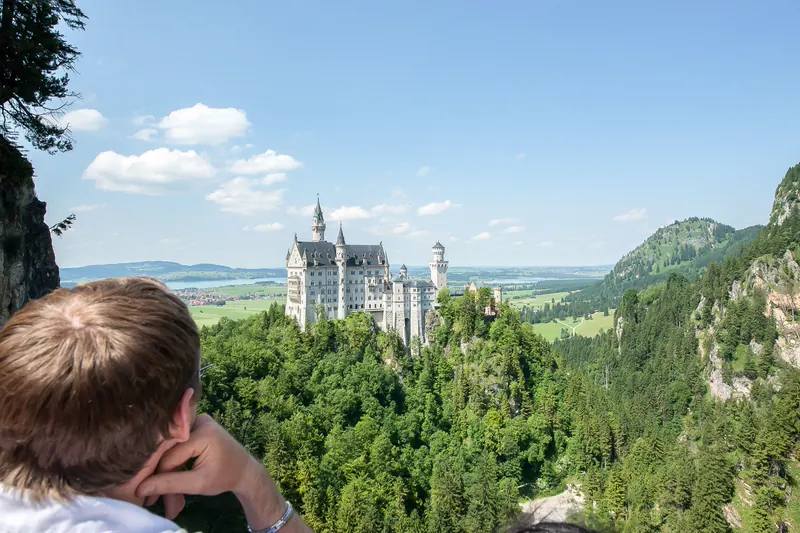
What people love, overwhelmingly: the dramatic Alpine setting, the fairy-tale exterior that Walt Disney drew on for Sleeping Beauty Castle, and above all the view from Marienbrücke (Mary's Bridge) above the Pöllat Gorge — widely called the best photo spot in Bavaria. The engineering and craftsmanship of what was finished — the Throne Hall, the Singers' Hall, the Wagner-opera murals — is genuinely impressive, and the castle's central heating, running water, and flushing toilets were cutting-edge for 1886.
Bottom line: Worth it, especially if you value the Alpine setting and the Marienbrücke photo. If opulent furnished interiors are your priority, pair it with Hohenschwangau Castle (Ludwig's fully-furnished childhood home) or add Linderhof Palace — both offer more interior completeness. Many visitors who skip the interior ticket and experience the free exterior say they'd happily do so again.
One common recommendation worth flagging: if interior tickets are sold out for your dates, the free exterior — the castle facade, grounds, and Marienbrücke — is not a consolation prize. It is, by many accounts, the better half of the experience.
Best time of year — and best time of day

Best season
May–June and September–early October are the strongest windows. Spring brings wildflowers and thinner crowds; Marienbrücke typically reopens mid-to-late April after its winter closure. September is a particular favourite — comfortable temperatures, fall foliage beginning around the bridge, and noticeably fewer day-trip coaches than July–August.
Summer (July–August) is warmest and everything is open, but the Bavarian Palace Administration's own materials note that "in the summer around 6,000 visitors a day stream through rooms that were intended for a single inhabitant." Tickets sell out weeks ahead and midday is genuinely very crowded.
Winter (November–March) offers the fewest crowds and, when conditions cooperate, a snow-covered castle that photographs beautifully. The caveat: Marienbrücke frequently closes for ice and snow, the shuttle bus won't run on icy roads, and getting both the snow scenery and bridge access on the same day is a gamble. The castle interior stays open year-round except 24, 25, and 31 December and 1 January, with reduced winter hours (10 a.m.–4 p.m.). For the full month-by-month breakdown — including the exact 2026 dates to avoid — see our best time to visit guide.
Best time of day
Go first or last. Organized coach tours from Munich typically arrive from around 10 a.m. and peak through early afternoon — described by multiple visitor guides as "a zoo." The first tour of the day gives you the calmest castle and the easiest parking; a late-afternoon slot (around 5 p.m. in season) rewards you with softer light and far smaller queues at Marienbrücke.
Marienbrücke timing tip: the bridge is free and independent of your tour time. If you hold a morning ticket, you can walk to the bridge after your tour; if you hold a late-afternoon ticket, go to the bridge first. Mid-day wait times of 15–30 minutes for an unobstructed photo are common in summer.
How long does it take — and what to bring
Realistic time on site: 3–4 hours
The guided tour is only ~30 minutes, but a realistic total on-site time is 3–4 hours:
- 30–40 minutes to walk the steep 1.5 km paved path up from Hohenschwangau (or shorter via shuttle bus / horse carriage, plus queue time at the stop)
- 10–15 minutes walk from the shuttle/carriage drop-off to the castle entrance
- 30–45 minutes for Marienbrücke — the walk there, any queue, and photos
- ~30-minute interior tour, preceded by arriving 20+ minutes early for the security check (the Ticket Centre recommends being in Hohenschwangau 1.5–2 hours before your Neuschwanstein entry time)
- Time for the café, balcony views, and the walk back down
If you combine Neuschwanstein with Hohenschwangau Castle and/or the Museum of the Bavarian Kings in the village, plan a half to full day. A Munich round-trip as a day trip runs 10–12 hours door-to-door.
What to wear and bring
- Sturdy closed walking shoes — the paths are steep, paved, and can be slippery (mud in spring, ice in winter). Good grip is essential.
- Layers — it is typically 2–3 °C cooler at castle elevation than in the valley, and the interior runs cool even in summer.
- Rain gear — the Allgäu Alps are genuinely rainy year-round; summer afternoons bring thunderstorms.
- Water and a snack for the climb. Some vendors and the shuttle bus are cash only — bring euros.
- Small bag only — large backpacks, hiking/military packs, prams and bulky items are not allowed inside the castle rooms.
- In winter: insulated, grippy footwear; temperatures at the castle can sit around −4 to +3 °C.
Tickets, accessibility, and 2026-specific notes
Tickets and booking
2026 adult admission: €21 (reduced €20), plus a €2.50 online booking fee. Children under 18 are admitted free but still need a booked timed ticket. Buy through the official ticket shop (ticket-center-hohenschwangau.de) well in advance — in summer, tickets for popular morning slots sell out weeks ahead. Same-day box-office tickets exist but cannot be reserved and disappear early. Our full guide to tickets and prices covers all options, refund rules, and how to guarantee entry from Munich.
Opening hours: 28 March–15 October 9 a.m.–6 p.m.; 16 October–27 March 10 a.m.–4 p.m. Closed 1 January and 24/25/31 December.
Accessibility
Partly accessible with advance planning. The approach is the hardest part — no cars reach the castle, and the steep 1.5 km paved climb has gradients of 12–19%. Three disabled parking spaces exist at car park P2. The horse carriage (folding wheelchairs only, no ramp) gets closest but still leaves a ~450 m uphill walk; the low-floor shuttle bus drops above the castle on a steep 500 m downhill approach, which is not recommended for wheelchairs or strollers.
Inside, an elevator allows wheelchair users to join a regular interior tour without the ~345 steps. Capacity is limited to one wheelchair user plus one companion per tour, and advance reservation by email is mandatory (not through the standard online shop). Strollers cannot enter the castle rooms but can be left in a designated stroller room.
2026: UNESCO inscription and ongoing restoration
On 12 July 2025, Neuschwanstein was inscribed as a UNESCO World Heritage Site alongside Linderhof, Herrenchiemsee, and Schachen — Germany's 55th site. Expect this to sustain demand and reinforce the case for booking well ahead.
The castle is also in the middle of its largest restoration in 150 years (~€20 million, covering 2,329 objects across 93 rooms). Tours have continued throughout, but parts of the interior may be under scaffolding on any given visit. The permanent tour group cap is currently 35 people (down from the pre-restoration high of ~58); the Palace Administration has indicated a future cap of around 45 after works complete, but this is not yet confirmed. Check the official Bavarian Palace Administration site for current room status before your visit.
See Neuschwanstein and Linderhof in one day from Munich
$88 · ★ 4.6 (15,000+ reviews) · ~10.5 hours · Free 24-hour cancellation
The most common way to handle the FAQ's biggest logistics question — how do I get there, park, get up the hill, and secure a timed interior ticket without juggling four separate bookings — is a bundled full-day coach from Munich. This tour handles the round-trip transfer, reserves the Neuschwanstein interior slot in advance, and includes Linderhof Palace in the same day. Audio commentary covers King Ludwig II's biography, his relationship with Wagner, and the story behind each castle.
- Round-trip coach from Karlsplatz 21, Munich
- Neuschwanstein + Linderhof in one 10.5-hour day
- Audio commentary in 9 languages
- Interior tickets optional (€42 adult, paid on bus by card)
- Free cancellation up to 24 hours before
Prefer a smaller group with skip-the-line entry already included? The Neuschwanstein skip-the-line ticket with audio guide suits independent travellers already in Füssen or Hohenschwangau.
From $88. Availability and final price on GetYourGuide.
Neuschwanstein visitor FAQ
Is Neuschwanstein Castle worth visiting?
Yes — but manage your expectations about the interior. The guided tour covers only about 14 of the originally planned 200 rooms, runs roughly 30 minutes, and bans photography. What visitors consistently rate highest is the fairy-tale Alpine setting, the exterior, and the panoramic view from Marienbrücke above the Pöllat Gorge. Many say the free outside experience alone justifies the trip. Pair it with Hohenschwangau Castle across the valley for fuller context on King Ludwig II.
What is the best time to visit Neuschwanstein Castle?
May, June, September, and early October on a weekday give the best balance of good weather, open Marienbrücke, manageable crowds, and full castle access. Summer (July–August) is the busiest season — up to 6,000 visitors per day — with same-day tickets gone by mid-morning. Within any day, the first tour of the morning and late-afternoon slots have the calmest conditions. See our month-by-month best time to visit guide for the exact 2026 dates to target and avoid.
Can you visit Neuschwanstein Castle for free without a ticket?
Yes — the exterior, surrounding paths, and Marienbrücke viewpoint are entirely free. Only the interior guided tour requires a timed ticket (€21 adult in 2026, plus a €2.50 online booking fee). Many visitors say the free exterior experience is the highlight of their trip regardless of whether they enter the interior rooms. You will still pay for the shuttle bus (~€3.50 up) or horse carriage (~€8 up) if you choose not to walk the steep 1.5 km path from Hohenschwangau village. See our detailed guide to visiting without a ticket for a full breakdown of every free area, what the €21 ticket actually gets you, and the current status of the Pöllat Gorge trail.
Is the Neuschwanstein interior tour available in English?
The official Bavarian Palace Administration tour is conducted by a live guide in the language allocated to your tour group — English slots are available but not guaranteed at every time. The audio guide (bookable separately or via GetYourGuide from Füssen Train Station) provides a fixed English commentary. From Munich, the full-day coach tour includes English audio commentary on the drive and before the interior; the official castle walk itself is allocated by the Palace Administration at the time of your visit.
How long does a full Neuschwanstein Castle visit take?
The interior guided tour is about 30 minutes, but plan 3–4 hours on site in total — accounting for the uphill walk or shuttle, the Marienbrücke detour, arriving early for security, the tour itself, and walking back down. If you're combining with Hohenschwangau Castle across the valley, plan a half to full day. A Munich day trip including Linderhof Palace runs about 10.5 hours door-to-door.