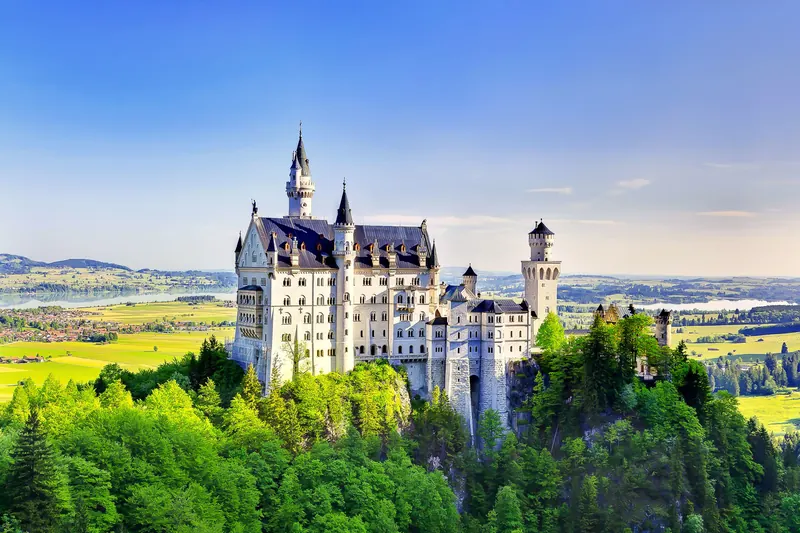
- 12 July 2025 Inscribed by UNESCO in Paris
- 4 palaces Neuschwanstein, Linderhof, Herrenchiemsee, Schachen
- 1868–1886 Built under Ludwig II
- 3 of 4 Open in winter; Schachen closes until June
- Under 18 Free at all Bavarian Palace Administration palaces
Four palaces, one World Heritage Site
On 12 July 2025, at its 47th session in Paris, UNESCO's World Heritage Committee inscribed "The Palaces of King Ludwig II of Bavaria: Neuschwanstein, Linderhof, Schachen and Herrenchiemsee" as a single World Heritage Site, Germany's 55th. The listing covers four palace complexes built between 1868 and 1886 by Bavaria's famously romantic, reclusive king. In winter you can visit three of them from Munich: Neuschwanstein, Linderhof and Herrenchiemsee are open daily apart from a few holiday dates. The fourth, the King's House on Schachen, is a remote mountain lodge that opens only in summer.
The calendar above is for the Neuschwanstein & Linderhof Castle Full-Day Trip from Munich (from US$88, rated 4.6 on GetYourGuide from over 17,000 reviews), a coach day trip that takes in two of the four UNESCO palaces in one winter day.
Ludwig II became King of Bavaria at 18, in 1864. He spent much of his reign retreating from politics into a private world of medieval legend, Wagner's operas and the absolutist splendour of Louis XIV's France, and he poured his fortune, and a great deal of borrowed money, into building it. When he died in mysterious circumstances in June 1886, his palaces were considered extravagant follies. Today they draw millions of visitors a year, and UNESCO has recognised them as one ensemble. Here's what that means, and how to see them.
The four palaces at a glance
Each palace is a different fantasy: a medieval castle, a rococo villa, a copy of Versailles and an alpine hut with an oriental hall inside. They also differ in what you can see in winter.
| Neuschwanstein | Linderhof | Herrenchiemsee | King's House on Schachen | |
|---|---|---|---|---|
| What it is | The medieval-fantasy castle on a crag | A small rococo "royal villa" in a mountain valley | A grand palace inspired by Versailles, on an island | An alpine wooden lodge with an exotic "Turkish Hall" |
| Built | From 1868–69; unfinished at Ludwig's death | Royal Lodge rebuilt from 1869; palace completed 1878 | Foundation stone 1878; unfinished at Ludwig's death | Planned from 1869, built 1870–1872 |
| Ludwig's time there | First lived there in 1884; died two years later | The only large palace he lived to see completed | Only a few days, in September 1885 | Birthday and name-day celebrations (25 August) |
| Famous for | The "fairy-tale" silhouette; Throne Hall; Singers' Hall | Hall of Mirrors; the Venus Grotto | Hall of Mirrors; it cost more than Neuschwanstein and Linderhof combined | Remote setting at about 1,866 m; Turkish Hall |
| Getting there from Munich | About 2 h by train and bus, or a Neuschwanstein & Linderhof Castle Full-Day Trip from Munich | About 1.5 h by road, often combined with Neuschwanstein on the same tour | About 1 h by train to Prien, then a ferry, or the Herrenchiemsee Palace and Boat Trip Day Tour | Long mountain hike only (6–7 h round trip) |
| Winter 2026–27 | Open daily 10:00–16:00 | Palace open daily 10:00–16:30; grotto and park buildings closed | Open daily (palace until 16:45) | Closed (open early June to early October) |
| Closed | 24, 25, 31 Dec, 1 Jan | 24, 25, 31 Dec, 1 Jan, Shrove Tuesday | 24, 25, 31 Dec, 1 Jan, Shrove Tuesday | All winter |
Tour prices on GetYourGuide checked 21 November 2026. The live price is on the booking page.
Other experiences you might enjoy
A palace trip from Munich can take in Neuschwanstein and Hohenschwangau Castle above the Alpsee, the rococo rooms of Linderhof Palace, the Hall of Mirrors at Herrenchiemsee on the Chiemsee, the old town of Füssen and, in December, the Christmas markets of Bavaria. Here are more tours and day trips in the area.
What does the UNESCO listing recognise?
- The name: "The Palaces of King Ludwig II of Bavaria: Neuschwanstein, Linderhof, Schachen and Herrenchiemsee", sometimes listed with the subtitle "– From Dreams to Reality".
- The date: inscribed on 12 July 2025 at the 47th session of the World Heritage Committee in Paris.
- Germany's 55th World Heritage Site.
- A "serial" site: four separate palace complexes inscribed together as one property, all built under Ludwig II between 1868 and 1886.
- The criterion: UNESCO inscribed the site under criterion (iv), as an outstanding example of a type of building or ensemble that illustrates a significant stage in human history.
- A little-known detail: Germany nominated the palaces on five criteria, but only one was accepted. UNESCO's advisory body, ICOMOS, judged that only criterion (iv) was met.
- The long road: the palaces had been on Germany's "tentative list" since 15 January 2015, first as "Dreams in Stone" with only Neuschwanstein, Linderhof and Herrenchiemsee. Schachen joined the nomination later.
What it means for visitors: in practice, very little changes. The palaces were already among Germany's best-protected and most-visited monuments. The listing does put them on the same global map as Versailles and the Alhambra, and it gives four very different buildings one story: a king's attempt to build a world of his own. Ludwig's life is told in full in King Ludwig II: life and legacy.
Neuschwanstein: the dream on the crag
- Building began in 1868–69, with the foundation stone laid on 5 September 1869. The finished interiors were completed only in 1884, and parts of the castle (the Bower and the Square Tower) weren't finished until 1892.
- It was inspired by medieval legend and by the operas of Ludwig's friend Richard Wagner. The Singers' Hall nods to Wagner's Tannhäuser.
- Around 200 rooms were planned, and only about 15 were completed, according to UNESCO's advisory body ICOMOS. The castle tour takes you through 14 of them; the second-floor rooms were never finished.
- Ludwig paid for it from his own fortune and loans, not state funds, and it ran far over budget.
- Ludwig first lived in the finished rooms in 1884. He died on 13 June 1886, and the castle opened to the public on 1 August 1886, just seven weeks later.
- It's widely cited as an inspiration for Disneyland's Sleeping Beauty Castle (1955). The claim that Walt Disney personally visited is often repeated but disputed.
- It drew about 1.1 million visitors in 2025, more than any other palace run by the Bavarian Palace Administration.
In winter: open daily 10:00–16:00 from 16 October, and closed on 24, 25 and 31 December and 1 January. With snow on its towers it's arguably the most photogenic of the four, but Mary's Bridge often closes in ice and snow. Book a timed ticket ahead, or join the Gray Line Premium Neuschwanstein & Linderhof Tour (from US$226, 4.8 from over 1,800 reviews), a small-group day trip with the tickets for both castles included.
Full guide: Neuschwanstein Castle from Munich in winter: the complete guide
Linderhof: the one he finished
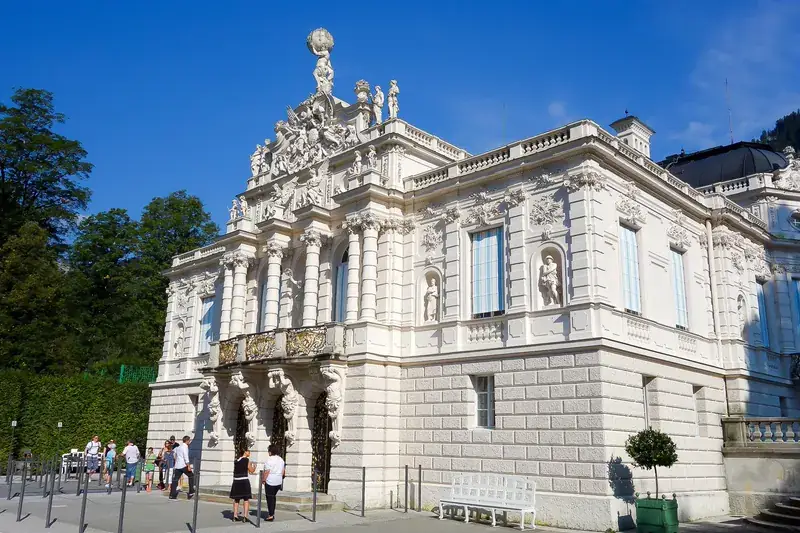
- Linderhof grew from a royal hunting lodge into an intimate rococo palace, completed in 1878, with its park finished in 1880.
- It's the only one of Ludwig's large palaces that he lived to see completed, and the one he spent the most time in.
- It's famous for its Hall of Mirrors, its terraced gardens and the Venus Grotto: an artificial cave with a lake and a gilded shell-shaped boat, where Ludwig could watch Wagner scenes lit in changing colours. The grotto reopened in spring 2025 after a ten-year restoration.
In winter: the palace is open daily 10:00–16:30, and the ticket office closes at 16:00. The Venus Grotto, the park buildings and the fountains are closed until mid-April, and the Moorish Kiosk is closed for restoration until the 2028 season. Linderhof also closes on Shrove Tuesday (9 February 2027). The easiest way to see it from Munich without a car is the Neuschwanstein & Linderhof Castle Full-Day Trip from Munich, which pairs it with Neuschwanstein.
Full guides: Neuschwanstein and Linderhof in one winter day · Linderhof Palace guide
Herrenchiemsee: Ludwig's Versailles
- Ludwig bought the Herreninsel, an island in the Chiemsee, in 1873. He laid the foundation stone of his "New Palace" on 21 May 1878, as a tribute to Louis XIV and Versailles.
- It cost more than Neuschwanstein and Linderhof combined, according to the Bavarian Palace Administration.
- Ludwig stayed there only a few days, in September 1885, and it was unfinished when he died. Parts were later demolished.
- Its showpiece is the vast Hall of Mirrors.
In winter: the New Palace is open daily 10:00–16:45 and is seen only on a guided tour of about 40 minutes, with the last tour at around 16:00. It's closed on 24, 25 and 31 December, 1 January and Shrove Tuesday. Boats run to the island every day of the year from Prien/Stock and Gstadt. The historic Chiemsee-Bahn tram from Prien station to the harbour doesn't run in winter (on the 2026–27 timetable it stopped on 25 October and returns on 1 May 2027), so allow 20–30 minutes for the 1.8 km walk. The Island ticket (New Palace, King Ludwig II Museum and Augustinian Monastery) costs €14, or €13 reduced, without the boat. In late November and early December you can combine the trip with the Fraueninsel island Christmas market, held Thursday to Sunday over the first two Advent weekends, which in 2026 means 26–29 November and 3–6 December. Full guide: Herrenchiemsee in winter: a day trip from Munich.
The Herrenchiemsee Palace and Boat Trip Day Tour (from €59, 4.8 on GetYourGuide from 150 reviews) does the train and boat from Munich with a guide; it's the only Herrenchiemsee day trip with a solid review record on GetYourGuide. More day trips from Munich are in Munich: what to see and day trips.
The King's House on Schachen: the hidden one
- It's a wooden alpine lodge, planned from 1869 and built 1870–1872, high in the Wetterstein mountains above Garmisch-Partenkirchen, at about 1,866 m.
- Behind its plain exterior is the Turkish Hall, an opulent oriental room where Ludwig celebrated his birthday and name day on 25 August.
- It can only be reached on foot. The round trip is a long mountain hike of around 6–7 hours.
In winter: closed. It opens from early June to early October, depending on the snow, and the inside is seen only on a guided tour (up to 30 people, €6 or €5 reduced). There's no day tour to it on GetYourGuide, so plan it as a summer hike.
Can you see all four palaces in winter?
Three of the four. In winter you can visit Neuschwanstein, Linderhof and Herrenchiemsee from Munich. Schachen is closed until June.
| How | Palaces | Days | Our pick on GetYourGuide |
|---|---|---|---|
| Neuschwanstein + Linderhof combo tour | 2 | 1 long day | Neuschwanstein & Linderhof Castle Full-Day Trip from Munich (from US$88, 4.6 from over 17,000 reviews) |
| Herrenchiemsee day trip (train + ferry) | 1 | 1 day | Herrenchiemsee Palace and Boat Trip Day Tour (from €59, 4.8 from 150 reviews) |
| All three | 3 | 2 days from Munich | The two tours above, on separate days |
Prices on GetYourGuide (US dollars, and euros for the Herrenchiemsee tour), checked 21 November 2026. The live price is on the booking page.
Avoid these dates for a palace trip: 24, 25 and 31 December and 1 January, when all three are closed, and Shrove Tuesday, 9 February 2027, when Linderhof and Herrenchiemsee are closed but Neuschwanstein is open.
Ticket tip: the old "Königsschlösser" combination ticket was discontinued at the end of 2025. If you plan to see all three palaces, the Bavarian Palace Administration's 14-day ticket (€40, or €80 for a family or two partners) covers Neuschwanstein, Linderhof and Herrenchiemsee. Even with it, you still need to book a timed slot at Neuschwanstein, paying only the booking fee, and it doesn't cover the privately owned Hohenschwangau Castle. Under-18s go free at all Bavarian Palace Administration properties.
Full guide: Neuschwanstein tickets in winter
Who was Ludwig II? The story in 60 seconds
- Born in 1845 at Nymphenburg Palace in Munich. He grew up partly at Hohenschwangau Castle, below the spot where he would build Neuschwanstein.
- Crowned at 18 in 1864. He was shy, idealistic and devoted to Wagner's music.
- After Bavaria lost political power to Prussia in 1866 and 1871, he withdrew into a world of his own making, building palaces as private retreats.
- His spending and eccentric behaviour led the government to declare him unfit to rule in June 1886.
- Days later, on 13 June 1886, he was found dead in Lake Starnberg, along with his psychiatrist. The circumstances remain a mystery.
- Seven weeks later, his "private refuge" at Neuschwanstein opened to paying visitors.
Full guides: Hohenschwangau Castle, where Ludwig grew up · King Ludwig II: life and legacy
Ludwig II's UNESCO palaces: FAQ
When did Neuschwanstein become a UNESCO World Heritage Site?
On 12 July 2025, when UNESCO's World Heritage Committee inscribed "The Palaces of King Ludwig II of Bavaria: Neuschwanstein, Linderhof, Schachen and Herrenchiemsee" at its 47th session in Paris. It became Germany's 55th World Heritage Site.
Which palaces are in Ludwig II's UNESCO World Heritage Site?
Four: Neuschwanstein, Linderhof, Herrenchiemsee (the New Palace) and the King's House on Schachen.
Can I visit all of Ludwig II's palaces in winter?
Three of the four. Neuschwanstein, Linderhof and Herrenchiemsee are open in winter, except on 24, 25 and 31 December and 1 January, and on Shrove Tuesday at Linderhof and Herrenchiemsee. The King's House on Schachen opens only from early June to early October.
Which of Ludwig II's palaces was the most expensive?
Herrenchiemsee. According to the Bavarian Palace Administration, it cost more than Neuschwanstein and Linderhof combined.
Did Ludwig II ever live in Neuschwanstein?
Only briefly. He first lived in the finished rooms in 1884 and died in June 1886, with the castle still unfinished.
Was Neuschwanstein the inspiration for the Disney castle?
It's widely cited as an inspiration for Sleeping Beauty Castle at Disneyland, which opened in 1955. Claims that Walt Disney personally visited Neuschwanstein are disputed.
Which Ludwig II palace did he finish?
Linderhof is the only one of his large palaces that Ludwig II lived to see completed.