- 23 Mornings with snow on the ground in an average January, in the valley below the castle
- 19 Snowy mornings in an average February
- 3–5 °C Typical January daytime high nearby
- 8½ h Daylight around the winter solstice
- 965 m Roughly the castle's height, at the very edge of the Alps
January and February give you the best chance of snow
If you want a snow-covered Neuschwanstein, go in January or February. In the valley just below the castle, snow lies on the ground on about 23 mornings in an average January and 19 in February. December is good but less reliable, with about 17 snowy mornings, and green Christmases do happen. November is mostly grey, cool and foggy, with only occasional early snow; our guide to Neuschwanstein in November covers that month's closures and dates. Expect daytime highs of about 3–5 °C in mid-winter, nights well below freezing and, around the solstice, only about 8½ hours of daylight. Snow is never guaranteed, so check the live webcams before you set off.
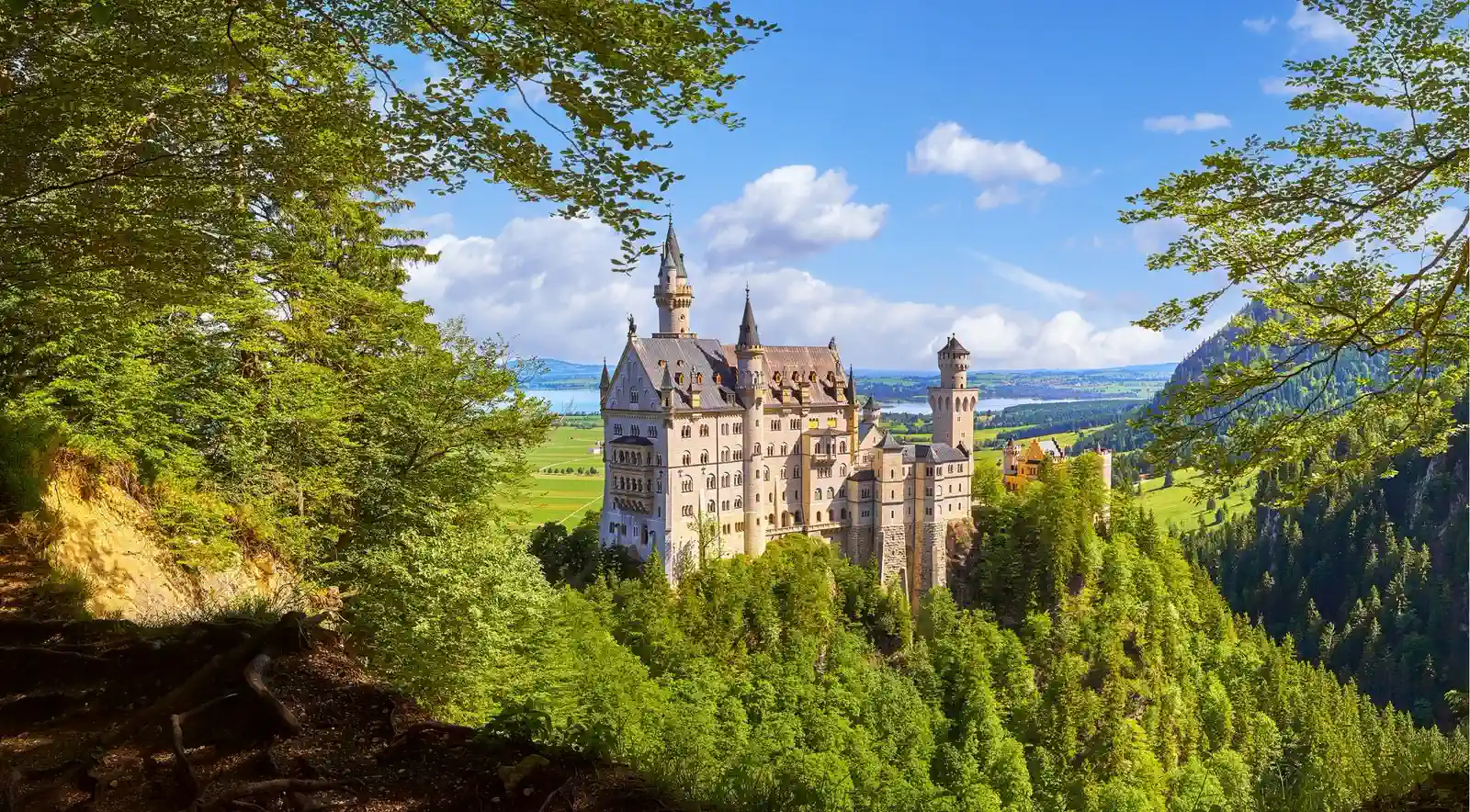
Everybody wants the photo: Neuschwanstein's white turrets rising from a snow-laden forest, the Alps behind, a pale blue winter sky. It happens often, but not on demand. The castle sits at roughly 965 m on the very edge of the Alps, where winters swing between deep snow, grey thaw and crisp, clear high pressure. The calendar above is for Radius Tours: Neuschwanstein Castle Full-Day Trip, a guided day from Munich that runs through the winter. Here's what the climate records say, month by month, so you can choose your dates and know what to expect.
Neuschwanstein winter weather at a glance
| November | December | January | February | |
|---|---|---|---|---|
| Typical daytime high | About 7–8 °C | About 3–4 °C | About 3–5 °C | About 3–5 °C |
| Typical night low | Around 0 °C | About −4 °C | About −4 to −5 °C | About −4 to −5 °C |
| Mornings with snow on the ground | About 7 | About 17 | About 23 | About 19 |
| Average rainfall (incl. melted snow) | About 98 mm | About 99 mm | About 90 mm | About 86 mm |
| Sunshine (hours/month) | About 75 | About 59 | About 70 | About 91 |
| Daylight (mid-month) | About 9h20 | About 8h28 | About 8h51 | About 10h16 |
| Crowds | Among the quietest months | Busy at weekends; peak 26–30 Dec | Busy to the end of the school holidays (8 Jan 2027), then quiet | Quiet, except the school-holiday week (8–12 Feb 2027) |
| Snow-photo chances | Low | Medium | High | High |
The castle stands about 200 m higher than the valley station that counts the snow, so snow often lasts a little longer up there. For the rest of the year, month by month, see our best time to visit Neuschwanstein guide.
November: quiet, grey and moody
What to expect: November is the transition month. Days are cool (around 7–8 °C), nights hover around freezing, and grey skies, drizzle and valley fog are more common than snow. Early snowfalls do happen, especially late in the month, but they rarely last.
Why go: it's one of the quietest months of the year at the castle. On a weekday you may share the courtyard with only a handful of others. When fog fills the valleys, the castle can sometimes sit above the cloud.
What's different in November 2026
- The Tegelberg cable car is closed for its autumn inspection from 9 November to 17 December 2026, according to the operator.
- The Museum of the Bavarian Kings is closed 9–11 November.
- The Zugspitze mountain railways close temporarily in November for maintenance, so check zugspitze.de for the exact dates before you plan a day there.
- Mary's Bridge is more often open than later in winter, although it isn't guaranteed. Our Mary's Bridge in winter guide explains how to check.
Other experiences you might enjoy
On a grey or snowy day, Neuschwanstein pairs well with Hohenschwangau Castle in the village below and the old town of Füssen. From Munich, winter day trips also go to Linderhof Palace, Oberammergau and the snow on the Zugspitze, and in Advent there are Christmas market tours.
December: Christmas markets and a decent chance of snow
What to expect: properly cold, with highs around 3–4 °C and frequent frosts. Snow becomes common, with snow on the ground on about 17 mornings in an average December in the valley below the castle. Mild spells and rain are common too, and the classic pre-Christmas thaw catches many visitors out.
Is there snow at Neuschwanstein at Christmas? Often, but not reliably. At the castle's height, snow on the ground at Christmas is more likely than not in a typical year. Some years are green, though, and visitors in late December have found the fields bare. Don't plan your whole trip around a white Christmas.
Daylight: the shortest days of the year, with about 8½ hours of light around 21 December. The sun rises around 08:00 and sets around 16:30.
What's different in December
- The castle is closed on 24, 25 and 31 December (and on 1 January).
- Füssen's Advent market runs only on 4–6 and 11–13 December 2026.
- 26–30 December are among the busiest days of the winter.
Our Neuschwanstein at Christmas and New Year guide covers the closed days and the busy ones in between.
January: the coldest month, and the best snow odds
What to expect: January is usually the coldest month, with days around 3–5 °C and nights around −4 to −5 °C in the valleys. Sharp cold snaps go much lower. Snow cover is at its most reliable now: in the valley below the castle, snow lies on about 23 mornings in an average January, more than in any other month.
Why go: after Epiphany (6 January) and the end of the Bavarian Christmas school holidays (8 January in 2027), the holiday crowds thin out and the castle enters its quietest snowy stretch. Clear, frosty high-pressure days give the sharpest light of the year.
Trade-offs
- Mary's Bridge is most likely to be closed for ice and snow.
- The shuttle bus rarely runs (it doesn't operate in snow or ice), so plan to walk or take a carriage. Our guide to walking up to Neuschwanstein in snow covers both.
- Daylight is still short, about 9 hours by mid-January.
February: our pick for a snowy, quiet visit
What to expect: temperatures much like January, but longer, brighter days. By mid-month you get about 10¼ hours of daylight, and February is the sunniest of the four months, with about 91 hours of sunshine against 59 in December. Higher up, February often has some of the deepest snow of the winter.
Why we like it: you get the best mix of snow, light and calm. The Christmas crowds are long gone, the days are noticeably longer, and snow still lies in the valley on about 19 mornings in an average February.
Watch out for
- Carnival (Fasching) week. The Bavarian school holidays bring a busier week, which runs from 8 to 12 February in 2027. Shrove Tuesday is on 9 February 2027.
- Linderhof and Herrenchiemsee close on Shrove Tuesday. Neuschwanstein doesn't.
Which winter month is best for Neuschwanstein?
| If you want… | Go in… |
|---|---|
| The best chance of snow | January or February |
| Snow plus longer days and few people | February (avoid Fasching week, 8–12 February 2027) |
| Christmas markets | Early to mid-December (Füssen market 4–6 and 11–13 December 2026) |
| A quiet visit before the snow | November (expect grey weather) |
| The best chance of Mary's Bridge being open | November or late March |
If your dates are already fixed, the castle tours still run in every one of these months apart from the four closed days around Christmas and New Year. The main differences are how you get up the hill and whether Mary's Bridge is open.
Fog, inversions and Föhn: the weather quirks to know
- Valley fog and low cloud are common on still winter mornings in the Alpine foothills. Cold air sinks and pools in the basins around Füssen and the Forggensee, while higher ground can be clear and sunny. On those days the castle ridge sometimes rises above the fog. Morning mist often burns off by midday, so check the webcams. Our guide to photographing the fog and snow has the viewpoints and the best hours.
- Inversions: climate records show the valley floors can have colder nights than nearby hilltops, a sign of cold air pooling. It's one reason the meadows below the castle feel so frosty at dawn.
- Föhn: occasionally a warm, dry south wind (the Föhn) brings sudden mild temperatures, crystal-clear views of the Alps and rapid snowmelt. It's great for photos and bad for snow.
Is winter at Neuschwanstein getting less snowy?
Yes, on average. At Höfen, next to Reutte just across the Austrian border, there was snow cover on around 105 days a year in 1991–2020, compared with about 133 days in 1961–1990. That's roughly four weeks fewer. Snowy winters still come, but the odds of a white castle on any given day are lower than a generation ago, which makes flexible dates and webcam checks more useful.
How to check the weather and snow before you go
- Official Ticket Centre webcams: hohenschwangau.de (Visitor information → Webcams)
- Schwangau tourism webcams: including views from the Tegelberg cable car and Hohenschwangau (schwangau.de/webcam)
- Füssen tourism webcams: including a view towards Neuschwanstein and the Tegelberg summit (fuessen.de/en/webcams)
- Daily status of Mary's Bridge, the shuttle bus and the carriages: the "Current information" box on the hohenschwangau.de homepage
Our routine: check the webcams and the official status box the evening before and again before you leave Munich. If fog is forecast, a later tour slot gives it time to lift.
What the weather means for your visit
- Snow or ice means no shuttle bus. Plan to walk the 1.5 km lane (30–40 minutes, longer in snow) or take a horse carriage. See walking up to Neuschwanstein in snow.
- Ice usually means Mary's Bridge is closed. Castle tours aren't affected. See is Mary's Bridge open in winter?
- Short days mean booking an early slot. A 10:00–13:00 tour leaves you daylight for the viewpoints.
- Cold plus a steep climb means layers. See what to wear to Neuschwanstein in winter.
If you'd rather not plan the trains and the timing yourself, Radius Tours: Neuschwanstein Castle Full-Day Trip (from $89, 4.7★ from 4,445 reviews) is a guided train day with free time in Hohenschwangau village. If you'd like Linderhof Palace in the same day, the Gray Line Neuschwanstein & Linderhof Full-Day Trip (from $88, 4.6★ from 17,296 reviews) is the most-booked coach day; Linderhof closes on Shrove Tuesday, so avoid 9 February 2027 for that one.
Daylight at Neuschwanstein in winter
| Date | Sunrise | Sunset | Daylight |
|---|---|---|---|
| 15 November | About 07:21 | About 16:43 | About 9h20 |
| 21 December | About 08:02 | About 16:28 | About 8h26 |
| 15 January | About 08:01 | About 16:51 | About 8h51 |
| 15 February | About 07:24 | About 17:38 | About 10h16 |
Neuschwanstein weather in winter: FAQ
Will there be snow at Neuschwanstein?
In January and February, very likely. In the valley just below the castle, snow lies on the ground on about 23 mornings in an average January and 19 in February. In December snow is common but less reliable, and in November it's occasional. Snow is never guaranteed, so check the webcams before you travel.
Is there snow at Neuschwanstein in December?
Often. In an average December, snow lies in the valley below the castle on about 17 mornings, but mild spells and thaws are common, especially around Christmas.
What is the coldest month at Neuschwanstein?
January is usually the coldest, with daytime highs around 3–5 °C and nights around −4 to −5 °C in the valleys. Cold snaps can go much lower.
What is the best month to see Neuschwanstein in snow?
January or February. February adds longer days and quieter crowds outside the Carnival school-holiday week, which runs from 8 to 12 February in 2027.
How many hours of daylight are there at Neuschwanstein in winter?
About 8½ hours around the winter solstice (21 December), rising to about 10¼ hours by mid-February.
Is Neuschwanstein foggy in winter?
Valley fog and low cloud are common on still winter mornings. The castle can sometimes sit above the fog, and morning mist often clears by midday.
Does bad weather close Neuschwanstein?
No. The castle tours run in all weathers. Snow and ice can close Mary's Bridge and stop the shuttle bus, though.